You are here
Feed aggregator
Flash flooding leaves Ross County families stranded after bridge washed out
CHILLICTOHE, Ohio (WCMH) -- Flash flooding in southern Ross County over the weekend has left many Central Ohioans’ properties underwater. "I’ve never seen US-23 flood before, especially in that area. That’s what we witnessed. It was pretty intense and rapid," Ross County resident Crystal McGrail said. McGrail lives in Waverly, US-23. Excessive rain on September [...]
Categories: Ohio News
One dead after fatal house fire in Lancaster
LANCASTER, Ohio (WCMH) -- One person is dead, and another person escaped safely after a house fire on Sunday afternoon. Crews responded to the fire around 2:15 p.m. at the 300 block of Williamsburg Lane. Red Cross and Charity Newsies are assisting the survivor. No other injuries were reported. The cause of the fire is [...]
Categories: Ohio News
AP Top 25: Ohio State drops to No. 6, Texas claims top spot after 1 point victory over Buckeyes
COLUMBUS, Ohio (WCMH) -- The Longhorns defeated the Buckeyes 24-23 Saturday, ending Ohio State's 3 game winning streak against No. 4 Texas and dropping them to No. 6 in the AP Top 25 ranking. Texas took the No. 1 spot, followed by Georgia, which remained at No. 2 after beating Western Kentucky 70-20. Newly unranked [...]
Categories: Ohio News
Repeat sex offender sentenced to 19 years on child pornography charges
NEWARK, Ohio (WCMH) -- Five years after a Licking County man was released following a decade behind bars for rape and sexual battery, he was sentenced to 19 years in prison for child pornography crimes. Christopher McInturf, 56, pleaded guilty in federal court in February to two counts of receiving and possessing child sexual abuse [...]
Categories: Ohio News
Fatal shooting of Columbus cousins remains unsolved after 14 years
COLUMBUS, Ohio (WCMH) — Columbus police continue to investigate a 14-year-old double homicide in which cousins were gunned down in a northeast Columbus home. On March 13, 2012, Antonio Bolden was visiting his cousin, Daniel Floyd, at an apartment in North Linden in the 2900 block of Cleveland Avenue, near Eddystone Avenue and the New [...]
Categories: Ohio News
Second teenager arrested in connection with fatal west Columbus shooting
COLUMBUS, Ohio (WCMH) -- A 17-year-old boy is the second teenager to be arrested in connection with the fatal shooting of a 20-year-old man at a west Columbus apartment complex. Officers said the teen suspect was arrested Thursday, following the arrest of a 17-year-old girl Tuesday. She told officers a dispute led to the shooting. [...]
Categories: Ohio News
PETA launches 'chicken war' against Columbus Raising Cane's
COLUMBUS, Ohio (WCMH) -- PETA began a "chicken war" against Raising Cane's on Thursday, parking a vegan chicken truck in front of the chain's campus location to promote going vegan. PETA's "Free the Chicken" truck will be parked in front of the campus Raising Cane's through Monday. The truck offers free vegan chicken fingers to [...]
Categories: Ohio News
Apple’s September Event: iPhone Duo, Apple Watch Series 12, and AirPods 5 #1877

In this episode, Ray Cochrane devotes the whole show to Apple’s fall event, the first under new CEO John Ternus. He starts with the iPhone Duo, Apple’s first foldable iPhone. From there, he covers the Apple Watch Series 12, the new Health Age score, the Apple Watch Ultra 4, and AirPods 5 with noise canceling at $129.
– Want to start a podcast? Its easy to get started! Sign-up at Blubrry
– Thinking of buying a Starlink? Use my link to support the show.
Subscribe to the Newsletter.
Email Ray if you want to get in touch!
Like and Follow Geek News Central’s Facebook Page.
Cochrane opens from his father’s studio in Michigan, fresh off a trip to Saugatuck Dunes State Park. Lake Michigan stunned him because it looked like the ocean. He had hoped to spot Wisconsin across the water. However, overcast skies and fog hid the far shore.
He also apologizes for the hum in the previous episode, his first video session in the studio. Without headphones on, he took the noise for ordinary background sound. The culprit turned out to be a line-level cable plugged in at one end and loose at the other. After tracing it, he rewired the whole desk so every cable is neat and out of harm’s way.
Meanwhile, he is still learning the studio’s TriCaster switcher and working on keeping his eyes on the camera. He invites listeners to send suggestions. Additionally, his grandmother had trouble finding the video version on the site. As a result, a site update is coming that uses the alternate enclosure feature, so listeners can switch between video and audio.
Time with his grandmother has been a highlight of the trip. Cochrane reflects on how little time he spent with this side of the family after his father moved to Michigan. Next, he flies home to Oregon after some time in Detroit. As the move comes together, he also wants a better way to get recordings off the TriCaster than a USB drive.
Sponsor: GoDaddyEconomy hosting $6.99/month, WordPress hosting $12.99/month, domains $11.99. Website builder trial available. Use codes at geeknewscentral.com/godaddy to support the show.
iPhone Duo: Apple’s First Foldable Arrives Seven Years After SamsungInstead of a spread of headlines, the whole episode covers Apple’s fall event, much like Chris’s recent D23 episode. The event streamed Wednesday as a pre-recorded film. It was also the first event under CEO John Ternus. He took over from Tim Cook, who became executive chairman, on September 1st.
It took Apple seven years to answer Samsung’s first Galaxy Fold. Even so, the price barely moved, since the Duo starts at $1,999. Cochrane admits he hoped for something closer to $1,400. Still, based on the marketing alone, the Duo is the upgrade he is most excited about.
The Duo is a book-style foldable that opens along a vertical hinge. Closed, it has a 5.4-inch outer screen and is roughly the size of a passport. Open, it reveals a 7.6-inch display, the largest Apple has put on an iPhone. Both screens share the same proportions, so apps simply scale up to fill the bigger screen.
Opened flat, the Duo is just 5.2 millimeters thick, which makes it the thinnest iPhone Apple has built. Closed, it measures 11.3 millimeters and weighs 254 grams. By comparison, Samsung’s Galaxy Z Fold8 is lighter and thinner at 201 grams and 4.5 millimeters open.
The Crease, the Hinge and the Return of Touch IDThe crease was Cochrane’s biggest worry, since it is the most common complaint about folding phones. Apple layers the inner screen with a flexible plastic cover, thin glass, and a titanium plate underneath. Custom adhesives let those layers slide as the phone bends. On top, a microscopically etched matte finish scatters reflections to hide the crease.
However, Apple only claims the crease is harder to see, not gone. Early hands-on reports split down the middle. Chance Miller at 9to5Mac found it “hard to notice a crease at most angles.” In contrast, Andrew Romero at 9to5Google, working from early videos, said it looks “just as visible” as on Samsung’s Fold8.
The hinge uses more than a hundred parts and a row of magnets to hold the phone shut. Cochrane says it snaps open cleanly, which a $2,000 phone should. Notably, the Duo carries an IP68 rating, surviving six meters of water for up to 30 minutes. That matters on a foldable, because dust in the hinge is a classic way these phones die.
The Duo also has no Face ID. Instead, a Touch ID fingerprint reader sits in the side button and works open or closed. Cochrane offers his own theory for the switch. With AI now able to generate convincing faces and video, a fingerprint may simply be the safer biometric.
Inside the Duo: Chip, Cameras, Software and BatteryThe Duo runs the A20 Pro, the same chip as the iPhone 18 Pro, built on a two-nanometer process. A vapor chamber carries heat away so the phone can hold full speed longer. Cochrane welcomes that, since his own phone runs hot while charging or running demanding apps.
Two 48-megapixel cameras sit on the back, a main and an ultra-wide. The outer screen unlocks the new tricks. For example, you can shoot selfies with the rear cameras, and Duo Preview lets your subjects see the shot. Smart Take snaps the photo when everyone is posing, and Kid Cue plays Peanuts animations to get kids to look at the camera.
On the software side, the Duo ships with iOS 27.1. The Dynamic Island now runs vertically along the side, and Split View puts two apps side by side for the first time on an iPhone. Netflix, Zoom and Slack already support it.
The Duo carries two batteries, one in each half, and Apple rates it for up to 24 hours of typical use. Charging to 50 percent takes about 20 minutes with a 60-watt adapter. However, that adapter is sold separately, which Cochrane calls out as a raw deal for first-time buyers. MagSafe and Qi2 wireless charging run at up to 25 watts.
Storage starts at 256GB for $1,999 and climbs to $3,199 for 2TB. Preorders open October 16th, and the Duo reaches stores October 23rd. Ternus called it “the most transformational change to iPhone since the original.” Cochrane still wants one, though the price gives him pause, and he asks listeners whether they plan to buy.
Apple Watch Series 12 Checks Your Heart Every Five SecondsNext, Cochrane turns to the Apple Watch Series 12 and its new Health Sensing System. The watch reads your pulse by shining green light into your skin and measuring what bounces back. After wrestling with the technical term, photoplethysmography, he notes that everyone sensibly calls it the optical sensor.
Apple made those lights bigger and more efficient. As a result, the watch now checks your heart rate every five seconds, all day. It also measures heart rate variability, the tiny wobble between beats, as often as every five minutes. A bigger wobble generally means your body is rested and recovered.
Cochrane loved Apple’s swimming ad, where a swimmer finishes his swim and checks his heart rate. To him, it feels far more futuristic than the rugged adventure watches of twenty years ago. Swim tracking itself isn’t new. What changed is the constant background check and a live heart rate readout on the watch face.
All of that feeds a new daily readiness score from zero to ten. It weighs your recent activity, training load, vitals and sleep, then updates through the day. Engadget points out that competitors already offer readiness scores and faster sampling. In Cochrane’s view, Apple is catching up to the market, but doing it in a big way.
Apple’s Heart Rate Accuracy StudyApple claims no wearable reads heart rate more accurately, and this time it published the study. Testers wore a Series 12 on one wrist and a rival on the other, with a Polar H10 chest strap as the reference. The rivals came from Garmin, Google, Huawei, Samsung, WHOOP and Oura.
Across 1,254 people at five sites, Apple led in 139 of 159 comparisons. Eighteen were too close to call. The only two losses went to Google’s Pixel Watch 4 at rest, by less than half a beat per minute. Cochrane appreciated that a fifth of participants had the darkest skin tones, where optical sensors have historically struggled.
The Series 12 comes in 42- and 46-millimeter sizes, including a new ceramic version. Battery life holds at 24 hours, and fifteen minutes of charging now buys up to twelve hours. Pricing starts at $399 for aluminum, $699 for titanium and $899 for ceramic. It reaches stores September 18th.
Health Age and Apple’s Rebuilt Health AppCochrane admits he first misread this feature, and he is glad his initial read turned out wrong. Apple is rebuilding the Health app around Apple Intelligence, its umbrella name for its AI features. The app adds an Insights tab, a For You section, and a Longevity tab covering seven areas of health.
Sumbul Desai, a physician who runs health and fitness at Apple, framed the goal. She said pairing the watch’s sensors with Apple Intelligence lets Apple “translate complex biometric data into clear guidance for users.” In other words, nobody wants to scroll through a spreadsheet of their own heartbeats.
Inside the Longevity tab sits Health Age. It weighs your VO2 max, resting heart rate, sleep, and heart rate variability against your real age. You can also add lab results like A1c and LDL cholesterol. Apple’s sample screen shows a body running 3.9 years younger than its birthday.
Cochrane finds the feature interesting, and he hopes the data stays private, much like health records at a hospital. However, Apple didn’t share the math behind Health Age. He would like Apple to publish its formula, because people will take a number like that seriously.
The new app also adds at-home movement evaluations using the iPhone camera and the watch. Users can book a $119 blood panel covering more than 50 biomarkers at roughly 2,000 Quest Diagnostics locations. Cycle Tracking gains perimenopause and menopause support. The redesigned app arrives later this year, while watchOS 27 lands September 14th.
Finally, Cochrane raises a concern about all this monitoring. He hopes Apple built strong safeguards around the health data, because a leak of data like this would bring serious lawsuits.
Apple Watch Ultra 4 Can Outlast a 100-Mile RaceThe Apple Watch Ultra 4 shares nearly everything with the Series 12, from the sensors to the S11 chip. This year, what sets it apart is stamina. Normal use now reaches 50 hours, up from 42, and Low Power Mode stretches to 84. Meanwhile, fifteen minutes on the charger buys up to 18 hours, where last year’s model managed 12.
A new Max Extended Workout mode tracks up to 45 hours of running or hiking, with GPS logging every second. Apple says that is typically enough to finish a 100-mile race. The watch also uses dual-frequency GPS, which listens to two satellite signals to reject readings bounced off tall buildings.
DC Rainmaker came away impressed with both watches. As Ray Maker put it, “I’d argue they’re the biggest leaps in Apple Watch hardware and features since they launched the Ultra series back a few years ago.” The Ultra 4 holds at $799 and ships September 18th.
Audio Intelligence and the Always-Listening QuestionBoth new watches also gain a set of listening features Apple calls Audio Intelligence. Sound Recognition alerts deaf or hard-of-hearing users to sirens, alarms, doorbells, or a crying baby. Shazam names nearby songs without being asked. Then come the two raising eyebrows: Live Rewind and Siri Recap.
Live Rewind shows the last fifteen seconds of your conversation as text with a double press of the Digital Crown. Siri Recap hands you a title and key points after a conversation, leaving out financial details and ID numbers. Both arrive in beta later this year, in English first, and need an iPhone 16 or newer.
Cochrane saw the pushback coming. To replay fifteen seconds, the watch has to be listening before you ask. Apple answers with privacy promises, including that everything is opt-in and raw audio is deleted after processing on the chip. Still, he argues that opting in means choosing to give up privacy, and he has a hard time believing the processing stays on the device.
AirPods 5 Bring Noise Canceling to $129AirPods 5 comes in two versions, and the headline is price. Until now, noise cancellation in the regular AirPods cost $179. Both AirPods 5 models include it, starting at $129.
Noise canceling is harder in the regular AirPods, because they lack the rubber tips that seal your ear. Apple’s AirPods marketing director Eric Treski admitted as much in 2024, calling it “really, really hard to create this great ANC quality in a non-ear-tip product.” Nevertheless, Apple says AirPods 5 removes up to 50 percent more outside noise than AirPods 4 with noise canceling.
Interestingly, the chip and microphones are unchanged. The gain comes from reworked vents and ports in the shell, plus smarter software. For perspective, Apple says AirPods Pro 3 still cancel up to three times more noise. Gizmodo found AirPods 5 “did a good job silencing the background noise, but not entirely.”
The $129 model charges over USB-C. For $149, you add a wireless charging case, a Find My speaker, a volume swipe on the stem, and an extra hour of listening. Both models also carry an IP57 rating and support Live Translation. They reach stores September 18th.
How Apple Filmed the EventCochrane closes by praising the production itself. Apple built different scenes and backgrounds throughout the film, and Six Colors noted a Hollywood backlot segment with a fake rainstorm, Roman soldiers, and astronauts. The closing card read “Shot on iPhone. Edited on Mac.”
He still hopes to get an iPhone Duo, though he isn’t sure about paying two grand. For now, he may stick with his current phone.
Cochrane wraps up by pointing listeners to the GNC Insider program, the newsletter, and podcastapps.com, adding that he likes Pocket Casts. Listeners can reach Ray or Chris at geeknews@gmail.com. He flies back to Oregon next, with another audio episode planned for Monday and a video site update coming this week.
The post Apple’s September Event: iPhone Duo, Apple Watch Series 12, and AirPods 5 #1877 appeared first on Geek News Central.
Categories: Podcasts
The Molkky Way
Categories: News
ANS-256 AMSAT News Service Weekly Bulletins

September 13, 2026
In this edition:
* Frank Hoonhaut, KJ7DZ, Sweeps AMSAT Award Ladder
* AMSAT Youth Initiative Adds “Satellite and Astronomy” Course
* ISAR Launches 2 Ham Band Satellites
* The Addictive World of Amateur Radio Satellites – An OARC Member Talk
* World Radio Broadcast & “Send Your Name into Space” Campaign
* Changes to AMSAT TLE Distribution for September 4, 2026
* Global ARISS Contact Window- Submit Your Proposals and Applications
* ARISS News
* AMSAT Ambassador Activities
* Satellite Shorts from All Over
The AMSAT® News Service bulletins are a free, weekly news and information service of AMSAT, The Radio Amateur Satellite Corporation. ANS publishes news related to Amateur Radio in Space including reports on the activities of a worldwide group of Amateur Radio operators who share an active interest in designing, building, launching and communicating through analog and digital Amateur Radio satellites.
The news feed on https://www.amsat.org publishes news of Amateur Radio in Space as soon as our volunteers can post it.
Please send any amateur satellite news or reports to: ans-editor [at] amsat.org
You can sign up for free e-mail delivery of the AMSAT News Service Bulletins via the ANS List; to join this list see: https://mailman.amsat.org/postorius/lists/ans.amsat.org/
Frank Hoonhout, KJ7DZ, Sweeps the AMSAT Awards LadderSome operators apply for an award. Frank Hoonhout, KJ7DZ, applied for the whole shelf. Bruce Paige, KK5DO, AMSAT Director of Contests and Awards, has announced that Frank, having decided to apply for “a few” AMSAT awards, has been awarded five of them at once: the Satellite Communicators’ Club Award, Oscar Satellite Communication Achievement Award #660, Oscar Satellite Sexagesimal Award #205, Oscar Satellite Century Award #64, and South Africa AMSAT Satellite Communication Achievement Award #US262.
Taken together, that is the complete AMSAT operating awards ladder in a single submission. The Satellite Communicators Club recognizes an operator’s first satellite QSO. From there, the Communication Achievement, Sexagesimal, and Century Awards recognize confirmed satellite contacts with stations in 20, 60, and 100 different U.S. states, Canadian call areas, or DXCC entities, respectively; the awards aggregate, so each rung’s contacts count toward the next, and all contacts must be made from locations within 25 miles (40 kilometers) of one another. The South Africa Satellite Communication Achievement Award, meanwhile, recognizes contacts with 25 unique stations via satellite. The serial numbers tell the story of just how steep the ladder gets near the top: 660 operators have claimed the 20-entity award, but Frank is only the 64th ever to reach 100.
Frank is no stranger to the awards desk. He earned GridMaster Award #66 in 2024 for confirming satellite contacts with all 488 grid squares in the contiguous United States, and satellite rovers know him for the “grids needed by the top grid chasers” map he compiled to help activators target the squares that matter most.
Operators looking to start climbing the ladder themselves will find complete rules for all of AMSAT’s operating awards at https://www.amsat.org/awards/.
Congratulations, Frank!
[ANS thanks Bruce Paige, KK5DO, AMSAT Director of Contests and Awards, for the above information.]
The AMSAT Youth Initiative has added its fifth online course, Satellites and Astronomy, to the Satellites in Space Help Us Live a Better Life on Earth series. The new course is now available at www.BuzzSat.com.

Satellites and Astronomy [Credit: NASA]
The course curriculum is broken down into three main sections:
-
Part One: An introduction to the formation of the universe and the properties of its heavenly bodies, providing a necessary starting point for understanding what satellites measure.
-
Part Two: A review of Earth-orbiting satellites used to investigate planets in our solar system and objects in interstellar space.
-
Part Three: An exploration of space-faring satellites that look beyond our solar system and galaxy to the edges of the universe.
Two additional chapters are also under consideration to familiarize learners with satellites that study the Moon and Mars.
Course Authors and Team ExpansionThis new curriculum was written by AMSAT member Eric Sonnenwald, N2XS, a Montclair State University M.S. graduate in Geosciences and former Science Curriculum Coordinator for Hardyston Middle School. Eric has authored the complete existing library of courses, which includes:
-
Satellite Meteorology
-
Satellites and Climate Change
-
Satellites and Pollution Control
-
Satellites and Natural Resources
Eric is currently finishing a course on Satellites and Fighting Wildfires and has begun work on two additional courses: Satellites and Communications and Satellites and Navigation.
At the same time, Vidya Gopalakrishnan, K4VGK, has joined the Youth Initiative as a fellow course writer and editor. Vidya helped edit the newly added course and is beginning work on her first courses, Introduction to Satellites and Amateur Radio Satellites – Communications and Telemetry.
Inspiring Future STEM CareersDesigned for junior high and high school students, these survey courses aim to interest youth in STEM subjects and careers in aerospace and engineering. ANS readers are encouraged to try out any of the courses at www.BuzzSat.com.
[ANS thanks Frank Karnauskas, N1UW, AMSAT VP of Development, for the above information.]
ISAR Launches 2 Ham Band SatellitesIsar Aerospace became the first commercial space company from Europe to successfully deliver satellites into orbit on its second flight. Mission ‘Onward and Upward’ lifted off from Isar Aerospace’s dedicated launch complex at Andøya Space in Norway at 20:12 UTC on Saturday, Sept. 5, deploying payloads in orbit. The payload included two CubeSats coordinated by the International Amateur Radio Union (IARU).
The mission Onward and Upward proved Isar Aerospace’s orbital launch capability. In parallel, the company has advanced its global network of available launch sites and is nearing completion of Europe’s largest integrated production facility for launch vehicles. In addition to the above developments, Isar Aerospace is constructing a launch complex in Nova Scotia, Canada, covering mid- to high-inclination orbits critical for Earth observation and communications.
The launch vehicles used to transport these satellites are developed, manufactured, and tested almost entirely in-house. Headquartered near Munich, Germany, Isar Aerospace was founded in 2018 and has grown to over 400 employees, working across five international locations. Spectrum launch vehicles 3-7 are already in production.
The mission’s payloads were selected through the Microlauncher Competition of the German Space Agency at DLR, which provides educational institutions and start-ups with low-cost access to space. The Microlauncher Competition is funded through the European Space Agency (ESA) Boost! program. The two amateur radio projects chosen were SpaceTeamSat1 and FramSat-1.
SpaceTeamSat1: SpaceTeam is a project of the Technical University of Wien, Austria, (TU Wien) that aims to get undergraduate students interested in space technologies, RF and amateur radio. This satellite is a 1U CubeSat equipped with a range of sensors connected to a Raspberry Pi. The processor runs code written by participating students. Young amateurs and students accompanied by an amateur operator will be able to – in coordination with TU Wien – upload and schedule their code themselves. There are also plans to open timeslots where the CubeSat acts as a data relay for amateur operators. A downlink on 437.395 MHz has multiple modes available from CW to up to 115200 baud using 2GFSK.
FramSat-1: Orbit NTNU is a project of the Norwegian University of Science and Technology at Trondheim, Norway. It is Norway’s largest student-led technical organization, and has been successful with a number of high-altitude balloon and sub-orbital launches, as well as SelfieSat, a 2U cubesat launched in 2022. FramSat-1 is a student-built 1U CubeSat engineered to develop certain satellite subsystems in-house and a functioning satellite bus capable of supporting a sun sensor payload. A downlink 435.141 MHz has been coordinated for 9600 bps AX.25 G3RUH FSK telemetry.
Both satellites are in sun-synchronous orbits of approximately 500 km altitude.
[ANS thanks Isar, IARU, SpaceTeam, and Orbit NTNU for the above information.]
Give Your Next Rove a Payload — Put Your Lunch into Orbit! Pack the rover dogs and hit the grid line with an all-new
AMSAT Round Logo Metal Lunchbox.
 Keep Amateur Radio in Space — and your lunch in the box!
https://www.zazzle.com/amsat_round_logo_metal_lunchbox-256761530568368967
The Addictive World of Amateur Radio Satellites – An OARC Member Talk
Keep Amateur Radio in Space — and your lunch in the box!
https://www.zazzle.com/amsat_round_logo_metal_lunchbox-256761530568368967
The Addictive World of Amateur Radio Satellites – An OARC Member Talk
The Online Amateur Radio Community (OARC) has published the video recording of a recent member talk exploring amateur satellite operations. Titled Chasing Birds: The Addictive World of Amateur Radio Satellites and presented by John Stringer, M5JFS, the presentation is now available to watch on YouTube.
Drawing on six years of operating experience, Stringer’s presentation provides a comprehensive entry point for operators interested in working amateur satellites. The talk traces his progression from using modest, readily available equipment to developing a more advanced station, offering a practical roadmap for newcomers.
Key topics covered in the presentation include:
-
Getting Started: Practical advice on utilizing basic equipment without requiring high-end initial investments.
-
Satellite Landscape: An overview of the various types of amateur satellites currently in orbit.
-
Station Requirements: Guidance on the essential gear needed to successfully access space-based transponders.
-
Operating Etiquette: Best practices for maintaining discipline, clarity, and courtesy during high-demand passes.
-
Software and Networks: Useful digital tools, tracking software, and social networks designed to support satellite operators.
-
Milestones: Notable achievements and experiences from Stringer’s six years on the birds.
In tandem with the video release, OARC highlights its ongoing community infrastructure for satellite enthusiasts. The organization maintains dedicated channels on its Discord server for general satellite discussions, weather satellite discussions, and specific regional or transponder projects such as QO-100.
Operators looking to engage with the community or explore further resources can access the following links:
-
Watch the talk: OARC YouTube Channel
-
Join the community: OARC Membership
-
Explore documentation: OARC Wiki Directory
-
Connect on X: Follow John Stringer M5JFS and AMSAT-UK
[ANS thanks OARC and AMSAT-UK for the above information.]
World Amateur Radio Broadcasting & “Send Your Name into Space” Campaign Amateur Radio Broadcasting EventFrom September 11 to 20, 2026, amateur radio digital broadcasts of postcards will be conducted almost worldwide from the Geoscan-2, Geoscan-4, and Geoscan-5 satellites using Geoscan’s own protocol.
These postcards feature the upcoming Ioffe-1 satellite. It is scheduled to launch in the winter of 2026–2027. Ioffe-1 is a scientific and educational nanosatellite. It is built by specialists from Geoscan and the ANO “Space Education Development.” The project operates within the Space-π framework. It is backed by the Foundation for Assistance to Small Innovative Enterprises (FASIE). The satellite’s payload includes a high-resolution camera. It also carries a scintillation gamma-ray detector developed jointly with the Ioffe Institute.
Amateur radio enthusiasts can independently receive and decode images from the CubeSats. To do this, follow the instructions here. Postcard transmissions will continue until September 20, 2026. Stations within the SONICS open network will decode postcards automatically. These images are gathered directly in the portal’s gallery section. As a reminder, Geoscan’s QSL program for radio amateurs remains active. For more information, see https://spacepi.space/news/vsemirnaya-radiolyubitelskaya-translyacziya/.
Observers can submit a report on the spot a satellite feature at the bottom of the AMSAT Status page.
Name Submission DeadlineThe Send Your Name into Space campaign for the Ioffe-1 is active. Participants have until October 15, 2026, to register online. Submissions can include a name, photograph, or drawing. All materials will be saved on a physical digital storage device and will be loaded onto the Ioffe-1 satellite. Once in orbit the nanosatellite will join the Supernova Hunters constellation.
This campaign builds on previous successes—such as the 2025 campaign where 7,887 names and over 3,500 images from 117 countries were uploaded. Sixty-seven top entries were selected for regular transmission from the 239Alferov satellite. For the current campaign, Mission Control Center specialists will select the 100 best hand-drawn works. These will be broadcast to Earth via amateur radio after launch. For more information, see https://spacepi.space/news/stante-chastyu-kosmicheskoj-missii-akcziya-otprav-svoyo-imya-v-kosmos-prodolzhaetsya/
[ANS thanks Spacepi for the above information.]
Annual memberships start at only $120.
https://www.amsat.org/join-the-amsat-presidents-club/
Changes to AMSAT TLE Distribution for September 11, 2026
Two Line Elements or TLEs, often referred to as Keplerian elements or keps in the amateur community, are the inputs to the SGP4 standard mathematical model of spacecraft orbits used by most amateur tracking programs. Weekly updates are completely adequate for most amateur satellites. TLE bulletin files are updated daily in the first hour of the UTC day. New bulletin files will be posted immediately after reliable elements become available for new amateur satellites. More information may be found at https://www.amsat.org/keplerian-elements-resources/.
Bulletin format elements for all satellites of interest to radio amateurs. This file is updated at least every 24 hours.
Bare elements are derived from the bulletin, but contain no header or footer. These data are used as input to the AMSAT Pass Predictions page.
This week there are no additions or deletions to the AMSAT TLE distribution.
General Perturbations Data SupportAMSAT is pleased to announce that modern forms of what are called General Perturbations data are being disseminated via modern formats including JSON, XML and KVN at https://newark192.amsat.org/gpdata/current/. The reason this change is being made is that we are running out of 5-digit catalog numbers and the TLE format is not viable for satellites launched after July of this year. See https://celestrak.org/NORAD/documentation/gp-data-formats.php for details.
These data are presently considered in beta test for the next two months while hosted on the test server newark192.amsat.org, and we are very open to community feedback at webmaster [at] amsat.org. Testers may experience outages and errors while we make improvements. We intend to put this into production on our main web server in July as we expect that satellites launched after this summer will require one of the new formats to accommodate longer object numbers. AMSAT will continue to publish TLE bulletins for satellites launched before July 2026 indefinitely.
[ANS thanks Joe Fitzgerald, KM1P, AMSAT Orbital Elements Manager, for the above information.]
Global ARISS Contact Windows: Submit Your Proposals and Applications ARISS Contact Proposals (U.S. only)
The proposal window opened on July 1, 2026, and closes on September 30, 2026, for contacts to be held from January to June 2027.To find more information and proposal instructions, visit this website: https://www.ariss.org/hosting-an-ariss-contact-in-the-us.htmlARISS Contact Applications (Europe, Africa and the Middle East) Schools and Youth organizations in Europe, Africa and the Middle East interested in setting up an ARISS radio contact with an astronaut on board the International Space Station are invited to submit an application from September to October and from February to April.
Please refer to details and the application form at https://www.ariss-eu.org/index.php/school-contacts.ARISS Contact Applications (Canada, Central and South America, Asia and Australia and Russia)
Organizations outside the United States can apply for an ARISS contact by filling out an application. Please direct questions to the appropriate regional representative listed below. If your country is not specifically listed, send your questions to the nearest ARISS Region listed. If you are unsure which address to use, please send your question to the ARISS-Canada representative; they will forward your question to the appropriate coordinator.For the application, click here.
- ARISS-Canada and the Americas, except USA: Steve McFarlane, VE3TBD
- ARISS-Japan, Asia, Pacific and Australia: Shizuo Endo, JE1MUI, Japan Amateur Radio League (JARL)
- ARISS-Russia: Soyuz Radioljubitelei Rossii (SRR)
[ ANS thanks ARISS.org for the above information.]
ARISS NewsAmateurs and others around the world may listen in on contacts between amateur radio operators at schools and astronauts and cosmonauts aboard the International Space Station. The downlink frequency on which to listen is 145.800 MHz worldwide.
Scheduled Contacts+ Recently Completed
No ARISS educational contacts were completed during the last week.
+ Upcoming Contacts
MAOU School No. 200, Belogorsk, Russia — direct via TBD
The ISS callsign is presently scheduled to be RSØISS
The scheduled crewmembers are Anna Kikina and Andrey Fedyaev
The ARISS mentor is RV3DR
Contact is go for Tue 2026-09-22 08:15 UTC
Many times, a school makes a last-minute decision to do a Livestream or runs into a last-minute glitch requiring a change of the URL, but ARISS may not get the URL in time for publication. You can always check https://live.ariss.org/ to see if a school is Livestreaming.
As always, if there is an EVA, a docking, or an undocking, the ARISS radios are turned off as part of the safety protocol.
+ Schedule of ISS radio power downs and power ups
Friday 2026-09-18 15:20 UTC Columbus module radio power down
Friday 2026-09-18 15:25 UTC Service module radio power down
Saturday 2026-09-19 13:46:39 UTC Progress 96P docking
Saturday 2026-09-19 19:05 UTC Columbus module radio power up
Saturday 2026-09-19 19:10 UTC Service module radio power up
Progress Cargo Resupply: Postponed
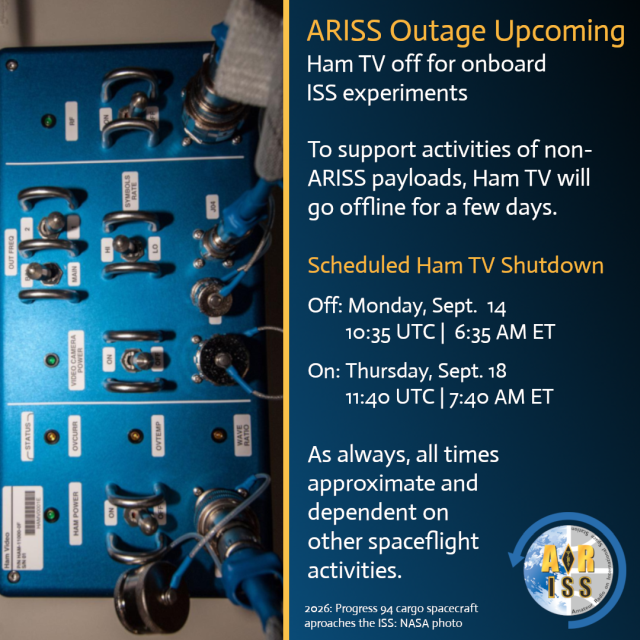
ISS HAM TV Outage [Credit: ARISS.org]
The crossband repeater remains configured in the Columbus Module (145.990 MHz up {PL 67} & 437.800 MHz down). If a crewmember decides to pick up the microphone and turn up the volume, you may hear the crew member on the air—so keep listening, as you never know when activity might occur.
Kenwood D710GA in the Zvezda Service Module – Callsign RSØISS. Please note we’re still in the process of troubleshooting and testing this radio. APRS is currently active on 437.825 MHz. Feel free to check out status reports at https://ariss-usa.org/ARISS_APRS/.
HamTV in the Columbus Module (2395.00 MHz) is currently transmitting a test signal. For more information, visit the ARISS Ham TV Live site at https://live.ariss.org/hamtv/.
Note that all times are approximate. It is recommended that you do your own orbital prediction or start listening about 10 minutes before the listed time.
The latest information on the operation mode can be found at https://www.ariss.org/current-status-of-iss-stations.html
The latest list of frequencies in use can be found at https://www.ariss.org/contact-the-iss.html
[ANS thanks Charlie Sufana, AJ9N, one of the ARISS operation team mentors for the above information.]
AMSAT Ambassador ActivitiesAMSAT Ambassadors provide presentations, demonstrate communicating through amateur satellites, and host information tables at club meetings, hamfests, conventions, maker fairs, and other events.
AMSAT Ambassador Clint Bradford, K6LCS, says,
“Think a 75-minute presentation on ‘working the easy satellites’ would be appropriate for your club or event? Let me know by emailing me at k6lcsclint [at] gmail [dot] com or calling me at 909-999-SATS (7287)!”
Clint has NEVER given the exact same show twice: EACH of the 150+ presentations so far has been customized to its audiences.
Scheduled EventsGreater Louisville Hamfest – September 12, 2026
Paroquet Springs Conference Centre
395 Paroquet Springs Drive
Shepherdsville, KY 40165-6007
https://louisvillehamfest.wixsite.com/louisvillehamfest
W4FCL
Bored Net µExpo and ARRL Santa Barbara Section Convention – October 3, 2026
Cal State University Channel Islands
1 University Drive
Camarillo, CA 93010
https://www.theborednet.net/index.php/2026/06/22/2026-microexpo-is-on/
K6KH
Tucson Area Autumn Hamfest – October 3, 2026
Radio Society of Tucson
Immanuel Presbyterian Church
9252 East 22nd Street
Tucson, AZ
https://k7rst.club
N1UW
44th AMSAT Space Symposium and Annual Membership Meeting – October 8 –11, 2026
Wyndham Jacksonville Hotel and Conference Center
14670 Duval Road
Jacksonville, FL 32218
https://www.amsat.org/2026-amsat-symposium/
Southern Arizona Fall Hamfest – November 14, 2026
Oro Valley Amateur Radio Club
Marana Middle School
11285 W. Grier Rd.
Marana AZ
www.tucsonhamradio.org/hamfest
N1UW
For more information go to: https://www.amsat.org/ambassador/
[ANS thanks Bo Lowrey, W4FCL, Director – AMSAT Ambassador Program, for the above information.]
Buying from Ham Radio Outlet?Add AMSAT’s Getting Started With Amateur Satellites to your order.
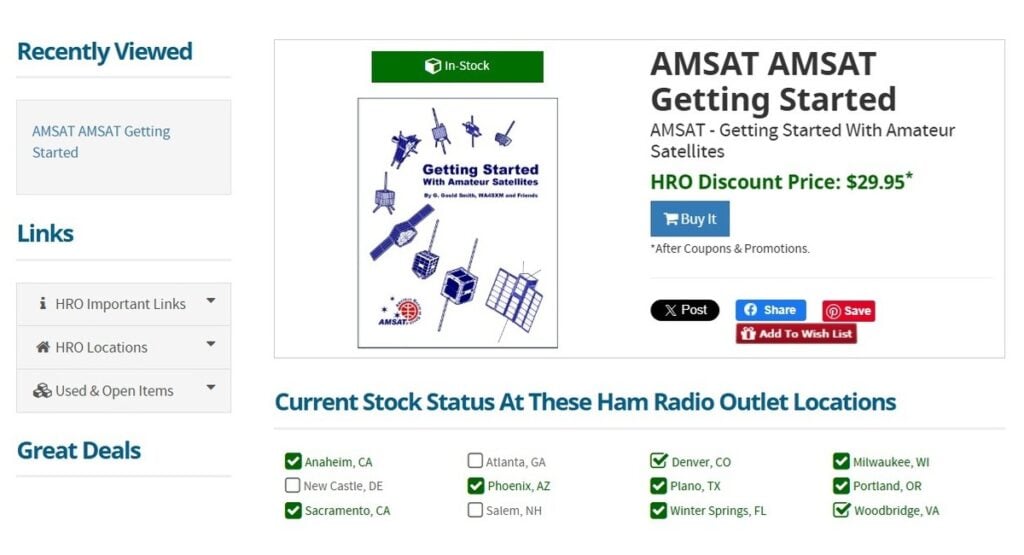 Available for $29.95 from HRO (free shipping on most orders over $100)
https://www.hamradio.com/detail.cfm?pid=H0-019238 Satellite Shorts from All Over
+ NASA’s Parker Solar Probe successfully checked in following its 29th perihelion, transmitting a normal system beacon tone on September 7, 2026. During the close approach on September 4, the spacecraft matched its record-breaking performance, sweeping within 3.8 million miles of the solar surface at a top speed of 430,000 miles per hour. Operating autonomously during the intense nine-day encounter window, the probe trained its cameras on structures near the Sun’s north pole and sampled nearly 40% of the solar circumference while diving deep into the corona. Detailed telemetry transmission begins September 11, with science data downlinks running from September 13 through September 27. Recently extended into 2029 by the Heliophysics Senior Review, the mission continues to capture vital insights into solar wind and space weather as the Sun transitions toward the declining phase of its solar cycle. [ANS thanks NASA for the above information.]
+ Astronomers at MIT and international institutions discovered a brand-new type of astrophysical object in the early universe known as a black hole star, using NASA’s James Webb Space Telescope (JWST). Designated MoM-BH*-1 and existing just a few hundred million years after the Big Bang, the object resembles a solar-system-sized star but shines 100 billion times brighter than any known star, producing an energy output typically associated with a black hole. Simulations indicate the object consists of a central black hole roughly 100,000 times the mass of the Sun enshrouded by an extremely dense, dust-free cocoon of hydrogen gas, mimicking a stellar appearance through its gaseous pseudo-photosphere rather than being powered by nuclear fusion. Published in Nature, the discovery could solve the mystery of the enigmatic “little red dots” frequently captured in deep-space JWST imagery. [ANS thanks MIT News for the above information.]
+ In a recent study analyzing a sample of about 100 fast radio bursts (FRBs), a Caltech research team led by Kritti Sharma and Professor Vikram Ravi used the data to directly measure the impact of galactic feedback on the clumpiness of intergalactic matter. Because normal matter acts as a scaffolding for dark matter, mapping this distribution enhances experiments tackling major cosmic puzzles, including the nature of dark matter, dark energy, and the mass of ghostly neutrinos. As researchers note, using FRBs as a leading cosmic probe is only just beginning. [ANS thanks Space.com for the above information.]
+ The Indian Space Research Organisation (ISRO) successfully launched the advanced Earth observation satellite EOS-05 aboard the GSLV-F17 rocket on September 4, 2026. Blasting off from the second launch pad at the Satish Dhawan Space Centre in Sriharikota at 2:55 a.m., the 19th flight of the GSLV precisely placed the 2,367-kilogram satellite into its intended sub-geosynchronous transfer orbit about 18 minutes later. Marking India’s first imaging satellite designed to monitor the Earth from a geosynchronous orbit roughly 36,000 kilometers above the surface, the milestone mission represents the 107th launch from the Sriharikota spaceport. [ANS thanks The Hindu for the above information.]
+ The Republic of Djibouti will formally sign the Artemis Accords during an in-person ceremony at NASA Headquarters on Monday, September 14, 2026, at 11:00 a.m. EDT. NASA Deputy Administrator Matt Anderson will host Djibouti’s Ambassador to the U.S., Mohamed Siad Douale, alongside U.S. State Department Assistant Secretary for African Affairs Frank Garcia at the signing, making Djibouti the 72nd nation to join the framework. Established in 2020 by the U.S. and seven founding nations, the Artemis Accords set practical principles for safe, transparent, and cooperative civil space exploration on the Moon, Mars, and beyond. Media representatives wishing to cover the event in person must RSVP to hq-media@mail.nasa.gov by 8:00 a.m. EDT on September 14. Further information and details on the accords are available on the NASA Artemis Accords page. [ANS thanks SciTechDaily for the above information.]
+ Adding to the vast array of new tracking programs now available, Avinstar, LLC announces the general availability of OsTrax, a satellite tracking and operating platform for Windows, macOS and Ubuntu. For more information, please view the OsTrax web site at https://www.ostrax.com or contact Jim McCullers at jmccullers@avinstar.com. [ANS thanks Jim McCullers, WA4CWI, for the above information.]
Join AMSAT today at https://launch.amsat.org/
In addition to regular membership, AMSAT offers membership to:
- Societies (a recognized group, clubs or organization).
- Students enrolled in at least half-time status are eligible for free membership to age 25.
- Memberships are available for annual and lifetime terms.
Contact info [at] amsat.org for additional membership information.
73 and remember to help Keep Amateur Radio in Space!
This week’s ANS Editor,
Vidya Gopalakrishnan, K4VGK
ANS is a service of AMSAT, the Radio Amateur Satellite Corporation, 712 H Street NE, Suite 1653, Washington, DC 20002
AMSAT is a registered trademark of the Radio Amateur Satellite Corporation.
Categories: Amateur Radio News
Ohio distracted driving law marks three years as crashes, deaths decline
COLUMBUS, Ohio (WCMH) -- Ohio’s distracted driving law is now three years old. The goal of the law was to create a stronger enforcement authority while also improving driver safety. David Berk, owner of Faith Driving School, said the law has led to safer roadways for all Ohioans. He noted it has reduced crashes, accidents and deaths. [...]
Categories: Ohio News
Sen. Jon Husted campaign staffer out after Nazi-related social media activity surfaces
COLUMBUS, Ohio (WCMH) -- Sen. Jon Husted’s campaign has parted ways with a top staffer after questions surfaced about social media activity that included a Facebook profile photo showing soldiers from a Nazi military unit. Stephen Woytek, 25, joined Husted’s campaign in August as political director in the Ohio Republican’s race against former Democratic Sen. [...]
Categories: Ohio News
Driver in deadly Ohio crash receives $5 million bond
LANCASTER, Ohio (WCMH) -- A Columbus man has received a $5 million bond in an aggravated vehicular homicide case, accused of crossing a highway median and striking another vehicle head-on in a fiery crash. The Ohio State Highway Patrol responded about 6:15 p.m. Sunday to a crash on U.S. 33 near U.S. 22 near Lancaster. [...]
Categories: Ohio News
Columbus man pleads guilty in three drive-by shootings, robbery
COLUMBUS, Ohio (WCMH) — A man arrested in connection with a 2025 drive-by shooting has pleaded guilty to multiple charges after being indicted in five cases, including two other drive-by shootings. According to Franklin County prosecutors, 20-year-old Kaden Ratcliff pleaded guilty to felony charges in five cases and could spend a quarter-century in prison. Charges [...]
Categories: Ohio News
Entertainment venue with multi-level go-kart track to open in Polaris area
COLUMBUS, Ohio (WCMH) – An entertainment venue chain featuring multi-level indoor electric go-kart racing has broken ground on a location near Polaris Fashion Place. Supercharged Entertainment began site work on Sept. 2 to construct a facility at 9300 Lyra Drive in north Columbus. The planned 125,000-square-foot entertainment hub is slated for a summer 2027 opening, [...]
Categories: Ohio News
Know before you go: Central Ohio fall apple and pumpkin picking
Central Ohio farms and orchards are inviting visitors to participate in various fall activities, such as apple and pumpkin picking, while following specific etiquette guidelines to prevent theft.
Categories: Ohio News
One dead after crash on I-70 West in east Columbus
COLUMBUS, Ohio (WCMH) -- One person was killed in a crash Friday evening on Interstate 70 West in east Columbus, according to police. The crash happened around 7:05 p.m. in the westbound lanes of I-70, west of South James Road. Police say Carl Moorer Sr., 45, was driving a 2003 Chevrolet Suburban when he lost [...]
Categories: Ohio News
Pages

Syndicate
Ohio News
- Kids' retailer, pizza shop to open at Tanger Outlets this year
- Joya's cafe in Worthington approved for significant expansion
- Groveport-Madison bus crashes into utility pole southeast of Columbus
- What permanent standard time would look like in Columbus
- Another surge in Columbus gas prices sees costs rise over $4.50 per gallon