You are here
Amateur Radio News
2026 Veterans Day - Amateur Radio Events. ARRL Closed Nov. 11
Many amateur radio clubs and organizations are planning on-air commemorations and special events for Veterans Day 2026. Visit the ARRL Special Events Stations database, and contact the following stations on-the-air:
- In Tampa, Florida, the American Victory Amateur Radio Club will be operating W4V, focusing on 14.265 MHz, on November 11 from 1500-2130 UTC. QSL via KE9VS.
- The USS Orleck Amateur Rad...
Categories: Amateur Radio News
A Century-Plus of Radio Innovation: The 102nd ARRL Handbook is Now Available
First published in 1926, The ARRL Handbook has helped generations of radio amateurs turn curiosity into knowledge, ideas into circuits, and experiments into new discoveries. Over the past century, it has evolved alongside radio technology, reflecting new developments and inspiring hands-on learning and experimentation.
Edited by Gregory D. Lapin, Ph.D., P.E., N9GL, the 102nd edition continues Th...
Categories: Amateur Radio News
ANS-312 AMSAT News Service Weekly Bulletins
November 8, 2026
In this edition:
- Apogee View
- NASA Announces Continued CubeSat Launch Initiative Missions
- AmsatDroid Free Resurrected as a New Android Satellite Tracker
- DXCC Satellite Standing November 2026
- VUCC Satellite Standing November 2026
- Changes to AMSAT TLE Distribution for November 6, 2026
- Ambassador Events
- ARISS News
- Satellite Shorts from All Over
The AMSAT(R) News Service bulletins are a free, weekly news and information service of AMSAT, the Radio Amateur Satellite Corporation. ANS publishes news related to Amateur Radio in Space including reports on the activities of a worldwide group of Amateur Radio operators who share an active interest in designing, building, launching and communicating through analog and digital Amateur Radio satellites.
The news feed on http://www.amsat.org publishes news of Amateur Radio in Space as soon as our volunteers can post it.
Please send any amateur satellite news or reports to: ans-editor [at] amsat.org .
Sign up for free e-mail delivery of the AMSAT News Service Bulletins via the ANS List. Join this list at: https://mailman.amsat.org/postorius/lists/ans.amsat.org/
Apogee ViewGreetings! It was great to see and spend time with many of you at our AMSAT Space Symposium in Jacksonville, Florida, in early October. Despite some challenges, including a nearby Hurricane Isaias, the event was well attended and productive. I’d like to personally thank Stephen Grant, KB4YKC, and Paul Locke, KB4PML, for hosting the event and, especially, for putting up with me.
 AMSAT President Drew Glasbrenner, KO4MA (Photo: AMSAT)
AMSAT is open to proposals to host next year’s Symposium; please contact me if you’d like to share your city with AMSAT for our annual meeting.
One of the more newsworthy announcements from Symposium was the release of information regarding new AMSAT LTM partners. Our LTM program provides a space-qualified CubeSat radio for qualified missions, with the agreement that the included 30 kHz-wide linear transponder be operated once in orbit. We initiated this program with HuskySat-1 (HO-107) and continued it with MESAT1 (MO-122).
The first of these partners is JoanSat, a 1U mission launching in November 2027. Our partnership with the JoanSat mission resulted directly from our presence at CalPoly’s CubeSat Developer’s Workshop in April 2026. JoanSat is well documented at joansat.org.
Our second new partner is Embry-Riddle Aeronautical University in Daytona Beach, FL. Their satellite is called COMET. COMET is planned as a 12U University Nanosat Program that will separate in orbit into two 6U satellites to test a 24 GHz steerable beam link between the pair. Each 6U will carry an independent AMSAT LTM.
Our third new partner is Rice University and their OwlSat mission. OwlSat is a 1U CubeSat with an Extreme Ultraviolet monitoring experiment. This project is in the early stages of development.
I’m still in discussions with a fourth partner who wishes to fly an LTM on a 3U CubeSat mission. Hopefully, by my next Apogee View, I’ll be able to share more details about this partnership. Keep in mind these five planned LTM satellites are in addition to the LTMs included in FoxPlus-A and GOLF-TEE!
Another announcement from the General Meeting part of the Symposium is regarding the creation of a High Orbit Committee. I want to assemble an AMSAT team to put together some notional payloads that we can shop to various rideshare providers.
In my presentation, I described this as having a plan for when the dog catches the car. As I have often written and spoken about, I have been reaching out to make contacts in the rideshare arena, trying to find us a ride to somewhere above LEO.
I am not focusing on any one orbit (such as GEO) because we must be flexible and open to any possibilities, whether it’s MEO, GTO, GEO or some exotic disposal orbit. Anything that gives us long access and a large footprint is of interest, and we need to actively pursue such opportunities. If this seems like something you have skills and interest in, please email me directly at aglasbrenner@amsat.org.
On November 2nd, I was honored to attend a kickoff meeting for the ARISS/AMSAT Amateur Radio Exploration (AREx) Lunar Team. Thank you to Frank Bauer, KA3HDO, for leading this initiative to include Amateur Radio in future lunar missions. AMSAT is proud to support this initiative, and I’m excited to see what we can do on or around the Moon! More to come on this soon!
Lastly, our treasurer, Steve Belter, N9IP, is looking for one or two assistants to help manage our financial efforts. If this is an area where you can assist AMSAT, please reach out to Steve or me to start a discussion.
73, Drew KO4MA
[ANS thanks Drew Glasbrenner, KO4MA, AMSAT President for the above information.]
The 2026 President’s Club Coin – Only a Few Weeks Left!
Help Support GOLF and FoxPlus.
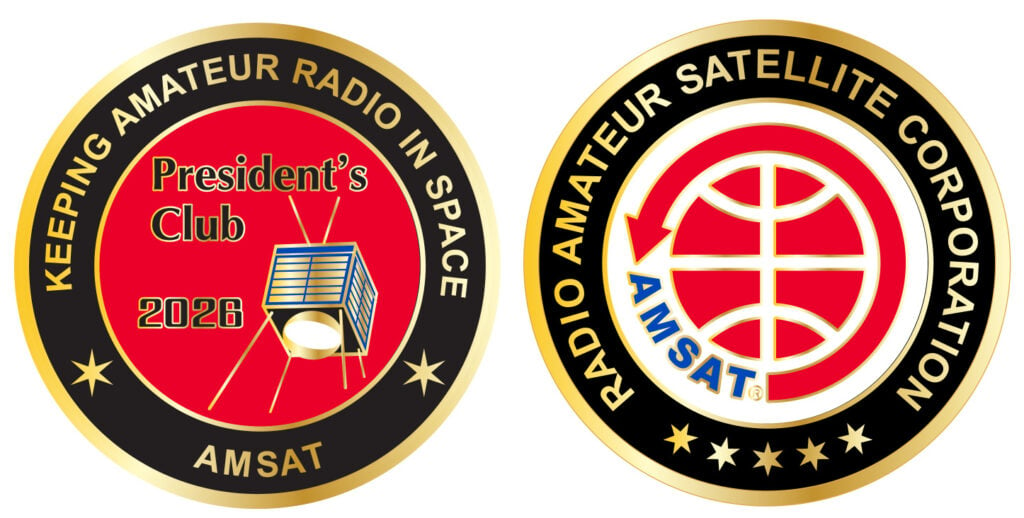
Annual memberships start at only $120
Join the AMSAT President’s Club today and help
Keep Amateur Radio in Space!
https://www.amsat.org/join-the-amsat-presidents-club/
Jerry Buxton, N0JY, AMSAT VP-Engineering reports that NASA has confirmed that their CubeSat Launch Initiative selections that were idled when CSLI went on hold will again be honored for both GOLF-TEE and GOLF-1 satellites.
Buxton explains, “Note that selection does not guarantee a launch, as has always been known as part of the CSLI process.
“However, since CSLI has been re-activated, we will not have to find a commercial launch.

“We are setting the deadline for GOLF-TEE to be “ready for handover” to a launch mission (integration) of December 15, 2027. This gives NASA a renewed and updated focus on our desired orbit that they use to match type of launch vehicle and the timing of a launch in order to get a ride coming as soon as possible after that date.
“As is usually the case, this means we may be manifested on a launch any time after the first of the year. That begins the launch mission process and the required paperwork that helps ensure our payload is safe and proper leading up to the actual integration date for that launch.
For the same reason, we have renewed/updated the readiness date for GOLF-1 to December 15, 2028.”
Jerry also noted that, “The agency anticipates releasing the next CSLI solicitation in 2028. NASA will provide additional information about eligibility, requirements, and how to apply closer to the solicitation’s release.”
[ANS thanks Jerry Buxton, N0JY, AMSAT VP-Engineering for the above information.]
AmsatDroid Free Resurrected as a New Android Satellite TrackerDavid Johnson, G4DPZ reports that an old satellite tracking friend for smartphones has returned to the living.
“I’m pleased to say I’ve resurrected AmsatDroid Free as a completely new implementation. The old app had aged out with the Android platform, so rather than patch it I rebuilt it from the ground up in Kotlin with a modern Jetpack Compose interface, while keeping the same proven SGP4/SDP4 orbit-prediction core (predict4java) under a regression test so predictions stay faithful.
 AmsatDroid Free unique night view (Photo: David Johnson)
“What it does:”
- Pass prediction for your location, with a sky view and a ground-track map
- Doppler-corrected downlink and uplink frequencies, updated live during a pass, including inverting (U/V) transponders
- Transponder frequencies come from Peter Goodhall’s (MM9SQL) OscarWatch database, synced automatically so they stay current
- Pass alerts with a countdown notification and optional spoken announcements
- Compass-oriented sky chart and an aiming aid for hand-held antennas
- An all-satellite overview of what’s up now and coming soon
- A home-screen widget for your next pass
- Automatic Keplerian element updates (Celestrak or AMSAT)
- Tablet and foldable layouts, per-app language, and a red night mode for observing without spoiling your night vision
“It runs on Android 11 and later and is free and open source (GPL-3.0). The source, with screenshots, is on GitHub:
https://github.com/g4dpz/AmsatDroidFree
“It will also be available on the Google Play Store in a few days, once account setup completes.”
[ANS thanks David Johnson, G4DPZ for the above information.]
AMSAT Remove Before Flight Key Tags Now Available
Yes, These are the Real Thing!
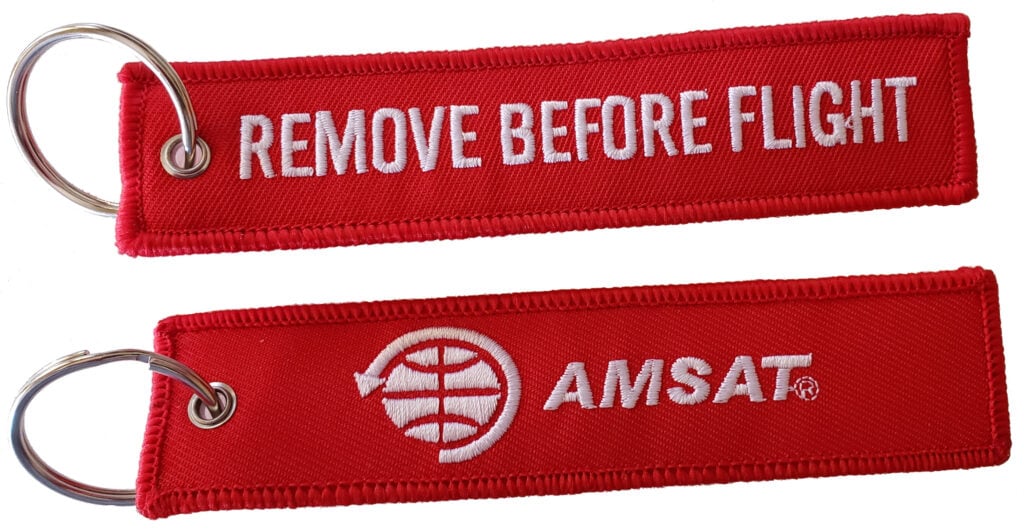
Your $20 Donation Goes to Help Fly a FoxPlus Satellite
Includes First Class Postage (Sorry – U.S. Addresses Only)
Order Today at https://www.amsat.org/product/amsat-remove-before-flight-keychain
DXCC Satellite Award/Endorsement Change Summary for October 01, 2026 to November 01, 2026.
.tg {border-collapse:collapse;border-spacing:0;} .tg td{border-color:black;border-style:solid;border-width:1px;font-family:Arial, sans-serif;font-size:14px; overflow:hidden;padding:10px 5px;word-break:normal;} .tg th{border-color:black;border-style:solid;border-width:1px;font-family:Arial, sans-serif;font-size:14px; font-weight:normal;overflow:hidden;padding:10px 5px;word-break:normal;} .tg .tg-baqh{text-align:center;vertical-align:top} OE9DGV 221 223 DL2GRC 203 206 F4BKV 187 200 G4WFQ 183 200 HB9RYZ 176 180 ON4AOI 176 178 EA2AA 174 176 IK0WMJ 159 163 EA1N 139 150 SM2OAN 117 123 OH3DP 114 119 SV8CKM 109 117 YB5QZ 100 117 W8LR 115 116 HB9BIN 105 106 JS1LQI New 100 ZS1A New 100Congratulations to the new DXCC Satellite holders:
JS1LQI
ZS1A
[ANS thanks Jon Goering, N7AZ, for the above information.]
VUCC Satellite Standing November 2026VUCC Satellite Award/Endorsement Change Summary for October 01, 2026 to November 01, 2026.
.tg {border-collapse:collapse;border-spacing:0;} .tg td{border-color:black;border-style:solid;border-width:1px;font-family:Arial, sans-serif;font-size:14px; overflow:hidden;padding:10px 5px;word-break:normal;} .tg th{border-color:black;border-style:solid;border-width:1px;font-family:Arial, sans-serif;font-size:14px; font-weight:normal;overflow:hidden;padding:10px 5px;word-break:normal;} .tg .tg-baqh{text-align:center;vertical-align:top} PY2PIM 1354 1426 EA2AA 1285 1301 JA1QJI 1006 1145 E70A 1126 1144 K9UO 1030 1040 W8LR 921 936 JS1LQI 876 934 VE7PTN 794 817 F6GLJ 805 811 WD9EWK 791 792 JH1NHK 500 705 JI5USJ 601 625 OH3DP 551 600 JI5RPT/1 400 500 K5WO 365 401 IK6GZM 234 235 PT2VM 150 200 KD8RTT 150 154 MM0INH 107 125 K7IU New 120 BA8BLK New 100 KO6MBI New 100Congratulations to the new VUCC Satellite holders:
K7IU
BA8BLK
KO6MBI
BA8BLK is first VUCC-Satellite holder from OM21.
[ANS thanks Jon Goering, N7AZ, for the above information.]
Need new satellite antennas? Purchase M2 LEO-Packs
from the AMSAT Store and Get Free Shipping!
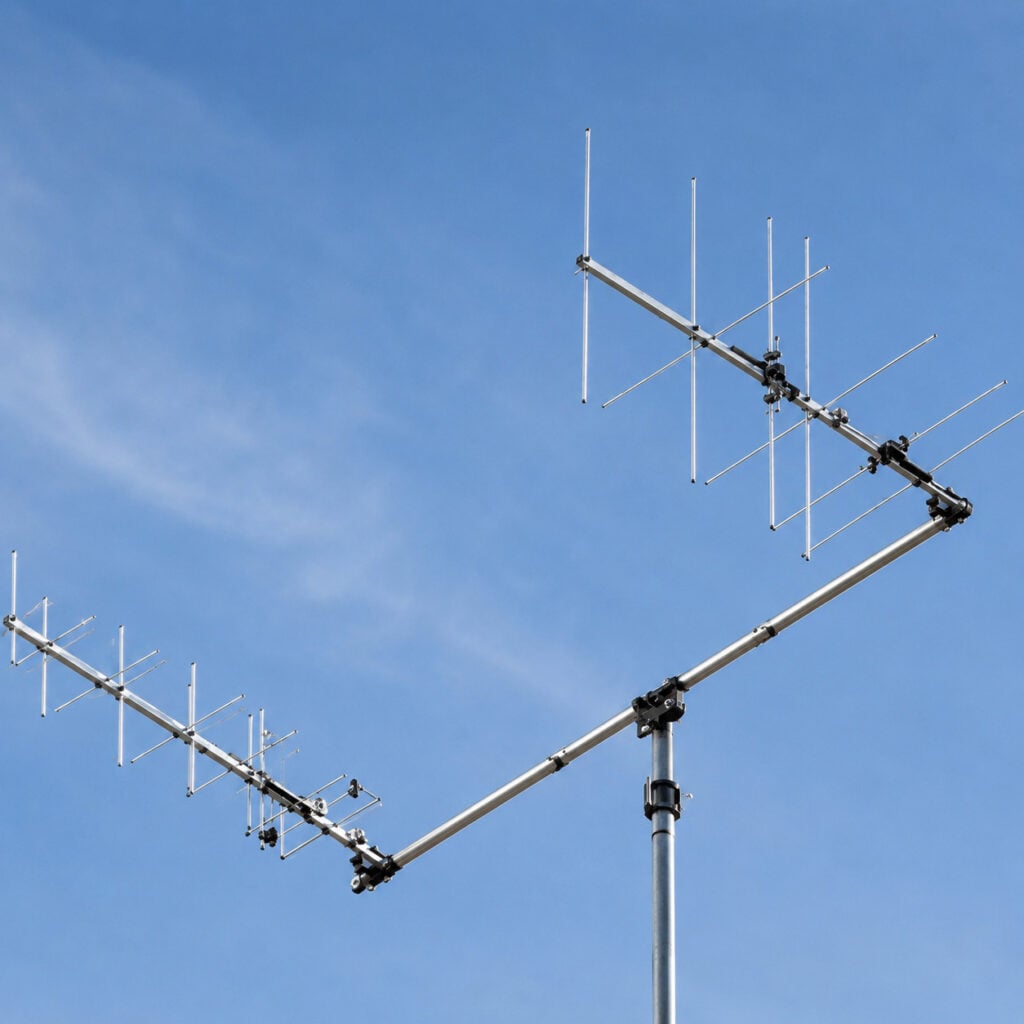
When you purchase through AMSAT, a portion of the proceeds goes towards
Keeping Amateur Radio in Space.
https://amsat.org/product-category/hardware/
Two Line Elements or TLEs, often referred to as Keplerian elements or keps in the amateur community, are the inputs to the SGP4 standard mathematical model of spacecraft orbits used by most amateur tracking programs. Weekly updates are completely adequate for most amateur satellites. TLE bulletin files are updated daily in the first hour of the UTC day. New bulletin files will be posted immediately after reliable elements become available for new amateur satellites. More information may be found at https://www.amsat.org/keplerian-elements-resources/.
This week there are no additions or deletions to the AMSAT TLE distribution.
General Perturbations Data Support
AMSAT is pleased to announce that modern forms of what are called General Perturbations data are being disseminated via modern formats including JSON, XML and KVN at https://newark192.amsat.org/gpdata/current/. The reason this change is being made is that we are running out of 5-digit catalog numbers and the TLE format is not viable for satellites launched after July of this year. See https://celestrak.org/NORAD/documentation/gp-data-formats.php for details.
These data are presently considered in beta test for the next few months while hosted on the test server newark192.amsat.org, and we are very open to community feedback at webmaster at amsat.org. Testers may experience outages and errors while we make improvements. We intend to put this into production on our main web server in July as we expect that satellites launched after this summer will require one of the new formats to accommodate longer object numbers. AMSAT will continue to publish TLE bulletins for satellites launched before July 2026 indefinitely.
[ANS thanks Joe Fitzgerald, KM1P, AMSAT Orbital Elements Manager for the above information.]
ARISS NEWSAmateurs and others around the world may listen in on contacts between amateurs operating in schools and allowing students to interact with astronauts and cosmonauts aboard the International Space Station. The downlink frequency on which to listen is 145.800 MHz worldwide.

- Scheduled Contacts
Pinecrest Academy of Northern Nevada, Sparks, NV, telebridge via IK1SLD.
The ISS callsign is presently scheduled to be OR4ISS.
The scheduled crewmember is Luke Delaney, KJ5PPF.
The ARISS mentor is Charlie Sufana, AJ9N.
Contact is go for Tuesday, November 10, 2026 at 18:16 UTC.
Watch for Livestream at www.youtube.com/@pinecrestnnvSS.
Ecole Secondaire du Sommet, Halifax, Nova Scotia, Canada, telebridge via VK4ISS.
The ISS callsign is presently scheduled to be NA1SS.
The scheduled crewmember is Joshua Kutryk, KJ5BFU.
The ARISS mentor is Wayne Harasimovitch, VE1WPH.
Contact is go for: Friday, November 13, 2026 at 18:07 UTC.
The crossband repeater continues to be active (145.990 MHz up {PL 67} & 437.800 MHz down). If any crewmember is so inclined, all they have to do is pick up the microphone, raise the volume up, and talk on the crossband repeater. So give a listen, you just never know.
As always, if there is an EVA, a docking, or an undocking; the ARISS radios are turned off as part of the safety protocol.
Note, all times are approximate. It is recommended that you do your own orbital prediction or start listening about 10 minutes before the listed time.
The latest information on the operation mode can be found at https://www.ariss.org/current-status-of-iss-stations.html
The latest list of frequencies in use can be found at https://www.ariss.org/contact-the-iss.html
[ANS thanks Charlie Sufana, AJ9N, one of the ARISS operation team mentors for the above information.]
LIMITED TIME OFFER!
AMSAT is offering a limited-time promotion for new and renewing members that includes a free digital copy of Getting Started with Amateur Satellites. The promotion is being offered as AMSAT begins the 2026 membership year.
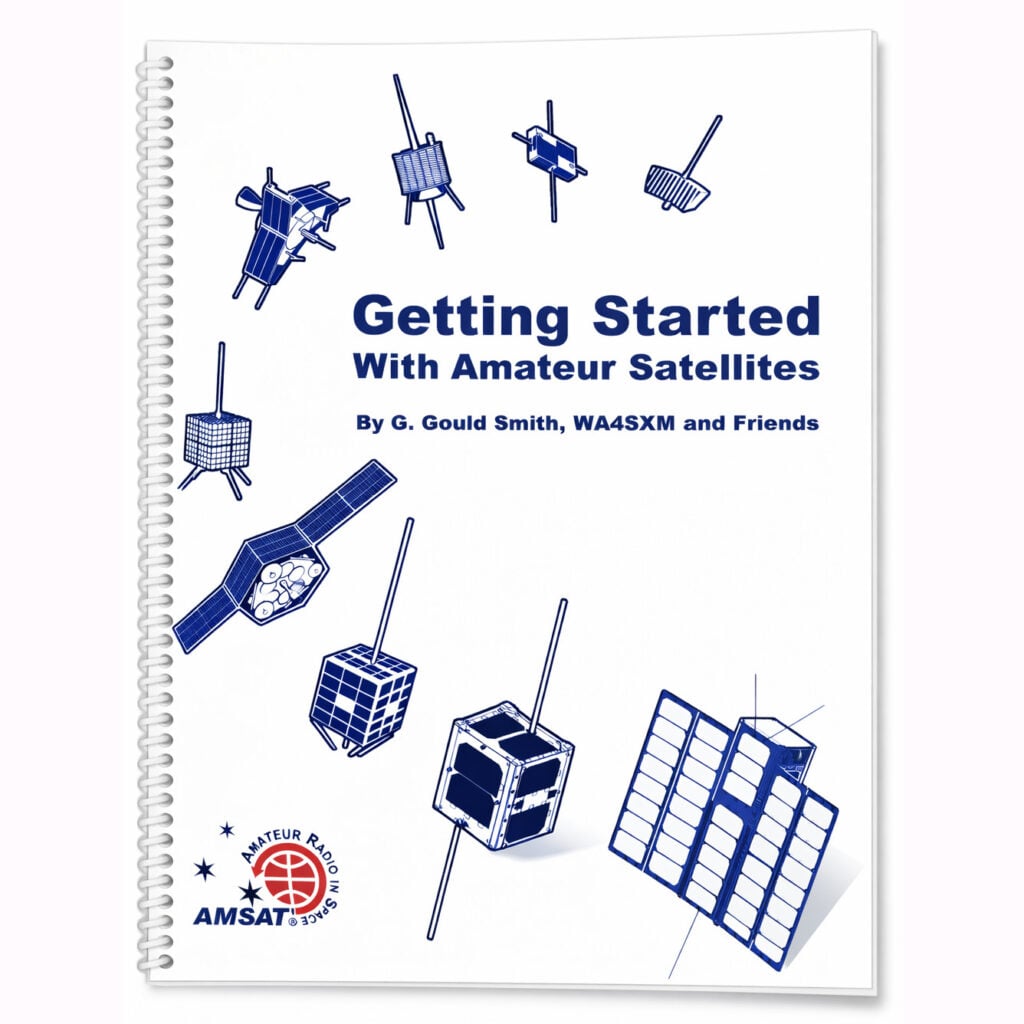
Anyone who joins or renews their AMSAT membership during the promotional period will receive a download link for the latest edition of Getting Started with Amateur Satellites in their membership confirmation email.
JOIN TODAY at https://launch.amsat.org/
(Remember! Students join for FREE!)
AMSAT Ambassadors provide presentations, demonstrate communicating through amateur satellites, and host information tables at club meetings, hamfests, conventions, maker faires, and other events.
November 14, 2026
Southern Arizona Fall Hamfest
Oro Valley Amateur Radio Club
Marana Middle School
11285 W. Grier Rd.
Marana AZ
https://www.tucsonhamradio.org/hamfest
N1UW
[ANS thanks Bo Lowrey, W4FCL, Director – AMSAT Ambassador Program, for the above information.]
Satellite Shorts From All Over- The 2027 CubeSat Developers Workshop (March 30 – April 1, 2027 at California Polytechnic State University, San Luis Obispo) is now accepting abstracts for oral and poster presentations. The Call for Abstracts opens today and closes Monday, January 11, 2027 at 11:59 PM Pacific Time. Submissions are open to industry, government, academia, and student teams. Submissions are peer-reviewed for relevance to CubeSat missions, technical quality, clarity, and potential impact. We encourage completed results and well-motivated in-progress work with credible test/validation plans. Notifications will be sent by the end of January. Complete information at https://cubesatdw.org . (Look for “Call for Abstracts.’) [ANS thanks cubesat.org for the above information.]
- The Goddard Space Flight Center Technical Career Panel is offering a live interactive session hosted as part of NASA’s Career and Technical Education (CTE) Day. The Goddard Space Flight Center Technical Career Panel is designed for high school, trade/technical, and college students, the program connects participants directly with NASA subject matter experts who build and test real-world spaceflight hardware, optics, and electronics. Students get a look at what a typical day looks like for technicians, machinists, and engineers who craft physical flight hardware rather than just traditional desk-based research. With live Q&A access, registered classrooms and students can submit questions ahead of time or live during the broadcast to ask engineers about their unique career paths, trade credentials, and schooling. The event is held on December 9, 2006 and the deadline for registration is December 2 at 11:59 PM ET. Educators and students can review the guidelines and sign up via the official NASA STEM Gateway Course Offering at https://tinyurl.com/ANS-312-Career-Panel. [ANS thanks nasa.gov for the above information.]
- A week doesn’t go by without ANS editors hearing about several new satellite tracking apps. Besides the above announcement about AmsatDroid’s resurrection, here are three more apps recently announced by ambitious hams. For one, look at https://orbitnight.com/radar/25544 that has the usual tracking, Doppler correction, rig and rotor control features. It also provides a unique channel plan with 5kHz channel steps and when to switch them for FM birds. For yet another way to go, see Deck at https://deck.map73.com. Deck is a browser based program that controls Icom handhelds with built in APRS, SSTV and Morse decoding. A third program, OrbitalRadar is unique in that it provides a sobering look at space congestion with its mind blowing 3D display of every satellite currently in orbit. Look for it at https://orbitalradar.com. [ANS thanks the OrbitNight, Deck and OrbitalRadar respectively for the above information.]
In addition to regular membership, AMSAT offers membership to:
Societies (a recognized group, clubs or organization).
Students are eligible for FREE membership up to age 25.
Memberships are available for annual and lifetime terms.
Contact info [at] amsat.org for additional membership information.
73 and remember to help Keep Amateur Radio in Space!
This week’s ANS Editor, Frank Karnauskas, N1UW.
f.karnauskas [at] amsat [dot] org
ANS is a service of AMSAT, the Radio Amateur Satellite Corporation, 712 H Street NE, Suite 1653, Washington, DC 20002.
AMSAT is a registered trademark of the Radio Amateur Satellite Corporation.
Categories: Amateur Radio News
The ARRL Solar Update
Solar activity is expected to be low in the coming days, according to NOAAís Space Weather Prediction Center, with a chance for M-class
flares and a slight chance for stronger X-class flares associated with sunspot region 4566, which is showing rapid growth in both size and magnetic complexity. No Earth-directed coronal mass ejections have been observed. Sunspot numbers are increasing from a low...
Categories: Amateur Radio News
ANS-305 AMSAT News Service Weekly Bulletins
November 1, 2026
In this edition:
- AMSAT OSCAR Satellite Status Page – New URL
- Spacewalkers Install Seventh Roll-Out Solar Array; Final Installation Set for November 5
- ARISS SSTV Series 34 Concludes
- UNNE-1B Heard Around the World as AMSAT-EA Commissions Its Newest PocketQubes
- IARU Coordinates HADES-L and PVDX; Three Requests Declined, Four New Applications Filed
- Polish Student CubeSat PUCHACZ Seeks IARU Frequency Coordination
- UMKA-1 Sends Telescope Images by SSTV
- ARISS Opens New U.S. School Contact Proposal Window
- FO-29 Full-Sunlight Season Enters Its Final Weeks
- FO-126 Conducting 5.84 GHz High-Speed Tests
- NASA Details Accelerated Artemis Plan: Earth-Orbit Lander Test in 2027, Lunar Landings in 2028
- HOA Lobbying Group Makes Blocking Amateur Radio Antenna Bill a Top Priority
- Changes to AMSAT TLE Distribution for October 30, 2026
- ARISS News
- AMSAT Ambassador Activities
- Satellite Shorts From All Over
The AMSAT® News Service bulletins are a free, weekly news and information service of AMSAT, The Radio Amateur Satellite Corporation.
ANS publishes news related to Amateur Radio in Space including reports on the activities of a worldwide group of Amateur Radio operators who share an active interest in designing, building, launching and communicating through analog and digital Amateur Radio satellites.
The news feed on https://www.amsat.org publishes news of Amateur Radio in Space as soon as our volunteers can post it.
Please send any amateur satellite news or reports to: ans-editor [at] amsat.org
You can sign up for free e-mail delivery of the AMSAT News Service Bulletins via the ANS List; to join this list see: https://mailman.amsat.org/postorius/lists/ans.amsat.org/
AMSAT OSCAR Satellite Status Page – New URLThe AMSAT IT Team and community volunteers have been working for a number of months to upgrade the AMSAT Status Page. This effort brings new features, a more modern technical implementation, and enables open-source development. One of the biggest changes is coming up on Wednesday, November 4th. The URL will switch to https://status.amsat.org. The API will be reachable at https://status.amsat.org/api/v1 [Overview].
Notification banners have been placed on both sites. The site migration will commence at 1400 UTC on November 4th. The IT Team expects up to two hours before all historical and current data is migrated to the new site. Once the migration is completed, the old site will automatically redirect users to the new one.
The AMSAT community, and others, are welcome and encouraged to engage in the ongoing development activity.
Problems/Issues/Questions/Requests/Suggestions should be submitted (as an issue) to the Github project repo here. You can also reach out in the AMSAT Discord server in the #open-source-dev channel. You may also contact the IT team via e-mail at IT at amsat.org.
[ANS thanks Matthew Alberti, KM4EXS, AMSAT IT Team Lead, for the above information]
AMSAT is offering a limited-time promotion for new and renewing members that includes a free digital copy of Getting Started with Amateur Satellites. The promotion is being offered as AMSAT begins the 2026 membership year.
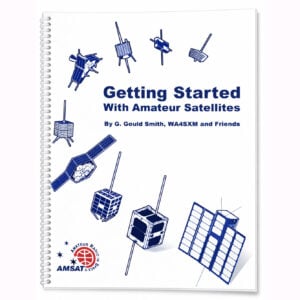
Anyone who joins or renews their AMSAT membership during the promotional period will receive a download link for the latest edition of Getting Started with Amateur Satellites in their membership confirmation email. JOIN TODAY at https://launch.amsat.org/ (Remember! Students join for FREE!)
Spacewalkers Install Seventh Roll-Out Solar Array; Final Installation Set for November 5NASA astronaut Anil Menon and Canadian Space Agency astronaut Joshua Kutryk, KJ5BFU, completed a 7-hour, 11-minute spacewalk on Thursday, October 29, installing and deploying the seventh of eight International Space Station Roll-Out Solar Arrays (iROSAs) on the station’s port truss. NASA reported the following day that the new array is generating power. The pair are scheduled to go back outside on Thursday, November 5, to install the eighth and final array, completing a power upgrade campaign that began in June 2021.
The spacewalk officially began at 7:57 a.m. EDT (1157 UTC) when the two astronauts switched their suits to battery power inside the Quest airlock. Menon exited first, followed six minutes later by Kutryk, who with that step became the fifth Canadian to walk in space. After reaching the iROSA carrier pallet on the truss, Menon climbed into a foot restraint on the end of the Canadarm2 robotic arm while Kutryk released the bolts holding the folded array in place. Menon, riding the arm, carried the 750-pound (340-kilogram) package to the P4 truss, where the two soft-docked it onto the mounting bracket in front of the station’s original 2A power-channel array at 10:40 a.m. EDT. Three of the four main power connectors were mated before the crew paused for an orbital day pass, since the connections must be made in darkness when the arrays are not generating power. Roll-out began at 12:21 p.m. EDT (1621 UTC), four hours and 23 minutes into the spacewalk, and about 12 minutes later the 63-foot (19-meter) array was fully extended, draping over roughly half of the legacy wing behind it. No motor was involved; the stored energy in the array’s rolled carbon-composite booms did the work, after which Menon drove two tension bolts to pull the blanket taut and mated the final connector during the next night pass.
Running about an hour ahead of the timeline, the spacewalkers then turned to get-ahead tasks for the second excursion, cleaning up the P4 worksite, removing the beams and booms that had secured the seventh array for launch, and releasing the anti-rotation devices and launch locks on the eighth array, which remains stowed on its carrier. The spacewalk ended at 3:08 p.m. EDT (1908 UTC) with airlock repressurization. NASA commentator Rob Navias described the outing as “essentially flawless.” Inside the station, NASA astronauts Luke Delaney, KJ5PPF, and Jessica Watkins operated Canadarm2, while NASA astronaut Nichole Ayers guided the spacewalkers from Mission Control Houston and CSA astronaut Jenni Gibbons served as capcom.
The excursion was the 285th spacewalk conducted in support of station assembly, maintenance, and upgrades, and NASA’s count also made it U.S. Spacewalk 100, the 100th conducted from the Quest airlock without a Space Shuttle docked to the station. The first, by Carl Walz and Daniel Bursch on February 20, 2002, had largely been a checkout of the then-new airlock. “This is USOS EVA 100, which is an incredible milestone,” Menon noted from outside. It was the fourth spacewalk for Menon, who arrived aboard a Soyuz in July and has now logged 26 hours and 31 minutes outside the station, and the first for Kutryk, who follows Chris Hadfield (2001), Steve MacLean (2006), Dave Williams (2007), and David Saint-Jacques (2019) on the short list of Canadian spacewalkers. Menon offered two observations for the ages, remarking “The night is dark and full of wonder” as he opened the airlock’s thermal cover at the start of the spacewalk, and “I can say it is always sunny in space” as it ended.
The two arrays for this round of spacewalks arrived at the station in the trunk of the SpaceX CRS-35 Dragon cargo spacecraft, which launched from Cape Canaveral on October 13. The iROSAs are mounted in front of the station’s eight original solar wings, which have exceeded their 15-year design life and degraded as expected, and each new array produces more than 20 kilowatts even while shadowing part of the older wing behind it. With all eight installed, NASA says the station’s generating capacity will rise from about 160 kilowatts to about 215 kilowatts, an increase of up to 30 percent that will support research and operations through the station’s planned 2030 retirement, including the power needed for its safe and controlled deorbit.
The second outing, U.S. Spacewalk 101 on November 5, will take Menon and Kutryk to the far starboard end of the truss to install the final array on the 3B power channel of the S6 truss segment. That worksite lies beyond the reach of Canadarm2, so the astronauts will have to “leapfrog” the array out to the end of the truss by hand, a more demanding task than Thursday’s robotics-assisted installation. NASA’s live coverage is scheduled to begin at 6:45 a.m. EST (1145 UTC) on NASA+ and the agency’s website.
The spacewalks matter to the amateur radio community for a practical reason. As a standing safety protocol, the ARISS radios aboard the station are powered off whenever a spacewalk, docking, or undocking is underway, so the Columbus Module crossband repeater and the Zvezda Service Module APRS digipeater were silent on Thursday and will be again on November 5. ARISS school contacts are also scheduled around spacewalk days; the ARISS operations calendar currently shows no contacts between the October 30 telebridge contact with The Smile of the Child in Greece (see ARISS News below) and the November 5 spacewalk.
[ANS thanks NASA, the Canadian Space Agency, Spaceflight Now, and Space.com for the above information.]
ARISS SSTV Series 34 ConcludesThe second ISS Slow Scan Television event of October has come to a close. ARISS SSTV Series 34, featuring images of ARISS hardware, began on Thursday, October 22, and concluded on Monday, October 26, at 17:45 UTC, giving stations around the world four days of passes to capture the Expedition 75 transmissions.
As with the Series 33 “Student Education” event earlier in the month, images were transmitted from the amateur radio station in the ISS Service Module under the callsign RS0ISS on 437.550 MHz FM using the Robot 36 mode, with each image taking 36 seconds to send followed by a gap of about two minutes. The 70-centimeter downlink meant a Doppler swing of roughly plus or minus 10 kHz across each pass, so stations that stepped their receivers through the pass, or that let their software do it for them, had the best chance of a clean decode. With only a 36-second transmission in each cycle, the event rewarded patience: a station that heard nothing simply waited two minutes for the next frame.
With the SSTV event complete, ARISS-Europe says the Service Module transceiver is being returned to APRS packet operation on 437.825 MHz, where it is expected to remain through the end of the year, except during spacewalks and other periods when the station’s amateur radios are switched off (see the lead story and ARISS News, below). Updates on future SSTV events are posted at https://www.ariss.org/upcoming-sstv-events.html and on the ARISS social media channels.
[ANS thanks ARISS, ARISS-Europe, and AMSAT-UK for the above information.]
UNNE-1B Heard Around the World as AMSAT-EA Commissions Its Newest PocketQubesFour weeks after launch, AMSAT-EA’s UNNE-1B PocketQube is in orbit, transmitting, and being decoded by ground stations around the world, while the organization works through the commissioning steps that will precede activation of its FM voice and data repeater. The status of its sister spacecraft, HADES-L, which shared the ride, has not yet been publicly reported.
Both satellites launched on SpaceX’s Transporter-18 rideshare mission from Vandenberg Space Force Base at 18:32 UTC on October 1, carried inside OSSIE-D, an orbital transfer vehicle built by the Spanish company UARX. OSSIE-D separated from the Falcon 9 upper stage roughly an hour after liftoff at an altitude of about 520 km. AMSAT-EA reported that UNNE-1B and HADES-L were then ejected from the transfer vehicle on Friday, October 2, at 11:48 UTC, considerably earlier than the days or weeks of orbit stabilization the team had cautioned might be required. The first UNNE-1B packets were received on October 4, and in an October 13 update the team at Universidad Nebrija in Madrid, whose students developed the satellite’s educational payload, said the amateur community had been receiving telemetry steadily since then, including the first packets from the on-board game.
UNNE-1B, also known as HADES-E2, is a 1.5P PocketQube that uses the same hardware and software as the original UNNE-1, whose planned launch aboard RFA One from the United Kingdom has been repeatedly delayed. Its SDR-based FM/FSK repeater listens on 145.925 MHz, accepting FM voice without any access tone along with FSK at 200 bps and AFSK AX.25 and APRS at 1200 or 2400 bps, and downlinks on 436.888 MHz. The repeater launched in mode 0, in which only telemetry is transmitted, and will be switched on by telecommand once in-orbit testing is complete; mode 1 provides the FM repeater for voice and data, and mode 2 a regenerative digital repeater. Once enabled, the UNNE-1B repeater is intended to remain continuously available, activated by carrier squelch. The satellite also transmits a CW beacon and a prerecorded CODEC2 digital voice message.
The educational payload is a deduction game, “Space Cowboy II,” written by Nebrija’s ARIES student group and running on an Arduino board. The satellite sends a telemetry packet, type 10, containing the game status and the number of weeks since release, and will transmit one clue per week; amateurs who collect the clues can attempt to solve the mystery of a lost spacecraft and an encrypted message. The telemetry uses FSK with about 1.64 kHz tone spacing and a 0xBF35 sync word, and decoder details are being published at https://www.nebrija.com/unne1b/en/index.html and on the AMSAT-EA website at https://www.amsat-ea.org/.
HADES-L is the more experimental of the pair. Measuring just 10 x 5 x 5 cm and generating an average of only 175 mW, it carries a transponder with an uplink on the 10-meter band, 29.472 MHz USB with about 3 kHz of bandwidth and no access tone, and an FM downlink on 436.665 MHz. The IARU completed coordination of a 436.665 MHz downlink and uplinks on both 29.472 MHz and 145.875 MHz on October 2 (see the coordination roundup below). Because of the tight power budget, the transponder is designed to operate for only four minutes out of every twelve, and the UHF transmitter switches between +13 dBm and +20 dBm depending on battery charge. AMSAT-EA recommends about 25 watts on the uplink and cautions operators not to overdrive the receiver’s AGC. The transponder can carry a single FM voice channel or several simultaneous CW, FT4, or FT8 signals, and the first Wednesday of each month is reserved for digital-mode experiments. Telemetry and experiment data, including measurements of the 30 MHz noise floor at orbital altitude, a radiation experiment comparing materials used in the spacecraft, and an evaluation of an electrically short receiving antenna, are transmitted at 800 bps.
Reception reports for both satellites are welcomed via the SatNOGS network and the AMSAT-EA website. The two spacecraft join AMSAT-EA’s HADES-SA (SO-127), launched in March, and bring the organization’s active fleet to a size that would have been hard to imagine when its first PocketQube, HADES-D (SO-121), was deployed in late 2023.
[ANS thanks AMSAT-EA, Universidad Nebrija, Felix Paez, EA4GQS, and Mineo Wakita, JE9PEL, for the above information]
IARU Coordinates HADES-L and PVDX; Three Requests Declined, Four New Applications FiledOctober brought a steady flow of activity to the IARU Satellite Frequency Coordination Panel’s status pages, hosted by AMSAT-UK at https://iaru.amsat-uk.org/index.php. Since ANS last reviewed the pages at the end of September, the panel has completed two coordinations, declined three requests, and posted four new applications from universities and student groups in Nepal, Louisiana, Utah, and Poland.
Coordination Completed
+ HADES-L – AMSAT-EA (coordinated October 2). The panel coordinated a downlink on 436.665 MHz and uplinks on 145.875 MHz and 29.472 MHz for the 10 x 5 x 5 cm experimental satellite described in the story above. The application, filed in July, proposed the 29 MHz uplink specifically to introduce a new challenge for the amateur community, as the 10-meter band is rarely used for amateur satellite uplinks. Coordination was completed the day after the satellite launched on Transporter-18.
+ PVDX – Brown Space Engineering, Brown University (coordinated October 12). The Perovskite Visuals and Degradation Experiment is a 3U CubeSat with three objectives: flight-testing an open-source, low-cost UHF amateur satellite radio board built around the AT86RF215 transceiver and inspired by the OpenLST design, which the students hope will cut the cost-performance ratio of amateur satellite radios; an outreach program in which primary and secondary students create pixel art using p5.js and receive back a photograph of their art displayed on the side of the satellite against the Earth; and monitoring the degradation of novel perovskite solar cells developed in Brown’s Padture lab. Up- and downlinks were coordinated on 437.765 MHz, using 9600 bps QPSK with convolutional coding, and on 2418.500 MHz, where a 50 kbps DVB-S2 downlink is planned. Launch is planned through Voyager Space from Cape Canaveral in 2027 into a 410 km, 51.6-degree orbit, suggesting deployment from the ISS.
Coordination Declined
The panel declined three requests on October 12, two of them with its reasoning noted on the entry:
+ UTNH-Sat – Universidad Tecnologica Nacional Regional Haedo, Argentina. Reported as a new application in ANS-270, the satellite proposed LoRa telemetry and a 20 wpm CW beacon on 436.850 MHz along with an automatic LoRa ping-response service that would reply to amateurs with their own callsigns, and a radiation-counter payload for educational use. The entry states only that the request has been declined; the application had indicated a planned SpaceX launch from Vandenberg in October.
+ GlobalGirlzSAT – Space Kidz India. A 12U CubeSat described as a space-education and international-collaboration mission carrying an Earth-observation camera, space-domain-awareness cameras, thermal and magnetic experiments, AI computing, materials research, and a drag-sail deorbit demonstration, with VHF, UHF, and S-band downlinks proposed using 9k6 GMSK and FSK for a November 2026 launch from Sriharikota. The panel declined the request “without a clear amateur mission that is fully separated from commercial, scientific and other non-amateur payloads.”
+ VinSat constellation – VinSpace JSC, Vietnam. Four 3U CubeSats intended for a 500 km, 47-degree orbit in the second quarter of 2027, with goals of capacity building for students and young engineers, space-environment study, and evaluation of an in-house payload, proposing a UHF BPSK downlink at 1k2 to 9k6 bps. Although telemetry and image data were to be unencrypted, payload data was to be encrypted, and the panel declined coordination “in the absence of a specific amateur radio mission.”
New Applications
+ Slippers2Sat-2 – Antarikchya Pratisthan Nepal (posted September 28). A 1U CubeSat with a disaster-assessment mission built around an array of four magnetometers intended to detect fluctuations in Earth’s magnetic field as possible earthquake precursors, plus near-infrared and RGB cameras for water-index imagery. The amateur payload is an AX.25 digipeater, and the team plans to downlink its magnetometer data and AI-filtered “good” images for about 24 hours at a time over the amateur downlink so that operators worldwide can receive, reconstruct, and upload them. The team has committed to publish its GMSK telemetry framing, decoding software, and documentation before launch, and proposes 4k8 GMSK and 20 wpm CW on UHF. Launch is planned via Exolaunch on a Falcon 9 from Vandenberg in mid-to-late 2027. More at https://s2s2.antarikchya.org.np/.
+ CAPE-Twiggs CubeSat – University of Louisiana at Lafayette (posted October 11). The responsible operator is Garth Likens, KJ5GYK. The 3U bus accommodates a modular array of “SlimSat” payload cards, and all of the schools involved will have students obtain amateur licenses as they design the hardware. The team proposes UHF and S-band downlinks using chirp spread spectrum (LoRa) with spreading factors adjustable between SF5 and SF12, and promises an open-source protocol with easy-to-use decoding software. No launch details have been provided. More at https://ee.louisiana.edu/research/cape.
+ RadiCAL Sat – Brigham Young University (posted October 12). The responsible operator is David Long, KA6WFX. The 1U CubeSat’s mission is a digital bulletin board system accessible to amateurs worldwide, allowing operators to read and post messages via 9600 baud FSK on UHF, while giving BYU students, who will become licensed as part of the project, experience in building spacecraft and operating amateur satellite links. Launch is planned through Exolaunch on a SpaceX mission from Vandenberg in the second quarter of 2027 into a 520 km polar orbit. More at https://spacecraft.byu.edu/.
+ Puchacz – AGH University of Krakow, Faculty of Space Technologies, Poland (posted October 19). The responsible operator is Jakub Kopec, SP9QBR. The 2U CubeSat from the AGH SatLab student group is presented as an amateur-educational mission under Section 5.4 of the ITU Handbook on Small Satellites, with its command link itself the subject of an experiment to minimize the number of telecommands needed for nominal operations. The amateur payload includes an in-house radio built around the Semtech SX1262 with a fully duplicated RF chain for radiation resilience, LoRa and GFSK transmissions at 19.2 and 38.4 kbps (some using IL2P framing), SSDV image downlinks from an RGB camera, and a “Message of the Day” service that replies to an operator’s ping with their callsign, a counter, and a daily quote. A multispectral camera and an experimental laser communication terminal will use a separate S-band downlink outside the amateur bands. The team proposes a UHF downlink using 125 kHz LoRa and GFSK, with launch planned on a SpaceX mission from Vandenberg no earlier than April 1, 2027, into a 525 km polar orbit. More at https://wiki.satlab.agh.edu.pl/.
[ANS thanks the IARU Satellite Frequency Coordination Panel and AMSAT-UK for the above information.]
AMSAT Remove Before Flight Key Tags Now Available Yes, These are the Real Thing!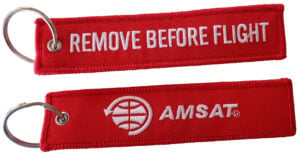 Your $20 Donation Goes to Help Fly a FoxPlus Satellite Includes First Class Postage (Sorry – U.S. Addresses Only) Order Today at https://www.amsat.org/product/amsat-remove-before-flight-keychain
Polish Student CubeSat PUCHACZ Seeks IARU Frequency Coordination
A Polish student satellite with an unusually extensive amateur radio payload has entered the IARU Amateur Satellite Frequency Coordination process.
PUCHACZ is a 2U CubeSat under development by SatLab AGH, a student research group at the AGH University of Krakow’s Faculty of Space Technologies. The IARU coordination status page listed PUCHACZ as its most recently updated application as of October 29. Frequency coordination remains in process.
The amateur radio system is more than a basic telemetry transmitter. Students plan to experiment with a custom command-and-control architecture based on the CubeSat Space Protocol, or CSP. Authenticated telecommands will be transmitted through the spacecraft’s 70-centimeter amateur radio command link, and the project intends to study ways of reducing the amount of uplink time required for routine spacecraft operations. Results are expected to be published for use by other amateur and student satellite projects.
PUCHACZ’s student-developed radio is based around a Semtech SX1262 transceiver with duplicated RF chains for increased resilience. Proposed amateur downlink modes include LoRa with 125 kHz bandwidth and GFSK at 19.2 and 38.4 kbps. Some GFSK transmissions will use IL2P framing.
One of the more interesting planned amateur experiments is image transmission. Pictures from the spacecraft’s RGB camera are expected to be encoded as SSDV and sent in either LoRa or GFSK/IL2P frames. The team says schedules and reception guides for both SX1262 receivers and software-defined radios will be published for amateur operators.
PUCHACZ will also offer a two-way “Message of the Day” experiment for licensed radio amateurs. An operator will be able to send a short packet containing a call sign and Maidenhead locator. The spacecraft will answer with a message containing the operator’s call sign, a count of answered requests, and a daily quotation.
Other experiments include the BEAR radiation payload, containing 12 dosimeters to compare the radiation-shielding properties of several biomaterials, and a custom pulse-power system associated with the DZIDA optical communications payload.
Outside the amateur-satellite service, PUCHACZ carries RGB and multispectral Earth-imaging cameras and DZIDA, an experimental infrared optical communications terminal. SatLab describes DZIDA as a wide-beam pulsed laser downlink intended to demonstrate an energy-efficient optical communications system suitable for small spacecraft. Full-resolution imagery and other non-amateur payload data are planned for a separate S-band link.
The current coordination filing anticipates a SpaceX launch from Vandenberg Space Force Base no earlier than April 1, 2027, targeting an approximately 525 km polar orbit. The university more generally lists the mission’s launch window as 2027.
As with all spacecraft in the IARU coordination process, proposed amateur frequencies and operating plans should not be treated as final until coordination is completed.
[ANS thanks the IARU Amateur Satellite Frequency Coordination panel, AMSAT-UK, and SatLab AGH at the AGH University of Krakow for the above information.]
UMKA-1 Sends Telescope Images by SSTVRadio amateurs had another opportunity to receive pictures directly from orbit this week as the Russian UMKA-1 CubeSat conducted an SSTV transmission campaign from October 27 through October 29.
The spacecraft transmitted on 437.625 MHz using the Robot 36 SSTV format. Images were scheduled at approximately 200-second intervals, although organizers cautioned that transmissions could be interrupted depending on the state of the spacecraft’s battery.
Two different images were included in the transmission sequence. Both were derived from photographs obtained by UMKA-1’s onboard telescope. The activity was organized in connection with educational activities for students.
The use of SSTV by educational satellites gives students and radio amateurs a particularly accessible way to receive spacecraft data: a suitable UHF receiving station, audio connection, and readily available SSTV decoding software are enough to turn a signal from orbit into a recognizable image.
UMKA-1’s activity came immediately after the International Space Station completed its own multi-day Series 34 SSTV transmission event, making late October an unusually active period for amateur satellite image reception.
[ANS thanks AMSAT Francophone for the above information]
It’s November! Time is running out for the 2026 President’s Club Coin!
Help Support GOLF and FoxPlus.
Annual memberships start at only $120
Join the AMSAT President’s Club today and help Keep Amateur Radio in Space! https://www.amsat.org/join-the-amsat-presidents-club/
ARISS Opens New U.S. School Contact Proposal WindowU.S. schools and educational organizations can now submit proposals for Amateur Radio on the International Space Station contacts planned for the second half of 2027.
The current U.S. proposal window runs from October through December 2026, with applications due December 31, 2026. Successful proposals from this window are expected to be scheduled for contacts taking place between July and December 2027. A second application window covering the same contact period will run from January through March 2027.
Scheduled ARISS contacts allow students to speak directly with an astronaut aboard the International Space Station during an approximately ten-minute radio window. Organizations may propose either a direct contact, in which amateur radio equipment is established at the school, or a telebridge contact using one of ARISS’s dedicated ground stations.
ARISS emphasizes that the radio contact should form part of a broader educational program rather than simply being a one-time event. U.S. proposals are expected to include plans for students to study subjects related to space technology, exploration, communications, wireless technology, or radio science.
Schools selected for a contact are assigned an ARISS Technical Mentor. ARRL and AMSAT can also assist participating organizations in locating a local amateur radio club to provide equipment, expertise, and educational support.
Application schedules differ outside the United States. Schools and youth organizations in Europe, Africa, and the Middle East use application periods organized by ARISS Europe, while other regions apply through their appropriate ARISS regional representatives.
[ANS thanks Amateur Radio on the International Space Station for the above information.]
Operators interested in working one of amateur radio’s longest-lived linear satellites may have only a few more weeks before Fuji-OSCAR 29 (FO-29) returns to periods of eclipse.
FO-29’s batteries have deteriorated over the past 30 years, leaving the satellite dependent on solar power to stay active for more than a few minutes. When its orbit remains continuously illuminated by the Sun, the V/U linear transponder can operate without the scheduled command activations required during portions of the year when the satellite enters Earth’s shadow.
A long period of continuous solar illumination began around May 20 and was projected to continue until approximately mid-November 2026. AMSAT’s current linear-satellite listing still reports FO-29 as being in full sunlight.
FO-29 carries an inverting V/U analog transponder:
* Uplink: 145.900-146.000 MHz, LSB
* Downlink: 435.800-435.900 MHz, USB
* CW beacon: 435.795 MHz
The satellite was launched in 1996 and remains under the control of the Japan Amateur Radio League. Its continued operation three decades later makes it one of the veteran spacecraft of the amateur satellite fleet.
As eclipses begin returning to its orbit, operators should not assume that the transponder will remain available continuously. During eclipse seasons the JARL control team may activate the satellite according to announced schedules when sufficient power is available.
[ANS thanks the Japan Amateur Radio League for the above information.]
FO-126 Conducting 5.84 GHz High-Speed TestsOrigamiSat-2 (Fuji-OSCAR 126 / FO-126), developed by the Institute of Science Tokyo, is conducting additional high-speed data transmissions on 5.84 GHz. The team has scheduled 500 kbit/s downlinks lasting approximately 10 minutes during selected passes through November 8, 2026. These tests support the satellite’s deployable membrane antenna technology demonstration and promotion of amateur use of the 5.8 GHz band.
FO-126 was launched April 23, 2026, on a Rocket Lab Electron and also carries a UHF downlink on 437.505 MHz (CW and 1200 bps AFSK). Operators interested in the C-band experiments are encouraged to monitor published pass times and share reception reports with the team.
[ANS thanks AMSAT-HB and the OrigamiSat-2 team for the above information.]
NASA Details Accelerated Artemis Plan: Earth-Orbit Lander Test in 2027, Lunar Landings in 2028NASA Administrator Jared Isaacman, Associate Administrator Amit Kshatriya, and Artemis Program Manager Jeremy Parsons laid out the agency’s plan for returning astronauts to the lunar surface during an October 23 news conference at Kennedy Space Center, confirming that Artemis III will fly a crewed Earth-orbit test of both commercial lunar landers in mid-2027 and that Artemis IV and Artemis V are both targeting crewed landings at the Moon’s south pole in 2028.
Under the revised architecture, Artemis III will no longer attempt a landing. Instead, Blue Origin’s Blue Moon Mark 2 lander will launch first, since it can loiter in Earth orbit for up to 30 days. A four-person crew will follow aboard Orion on the Space Launch System, docking with Blue Moon on the third day of the mission and spending two days attached while the astronauts enter the lander and run through its systems. SpaceX’s Starship Human Landing System will launch on day six with a passive docking adapter; Orion will dock with it for about two hours, though the crew will not go aboard. The flight is intended to wring out the rendezvous and docking operations that both landers will need before anyone commits to a lunar descent.
The two landers will reach the Moon by different routes. For Starship, a fully fueled vehicle will dock with Orion in Earth orbit and push the capsule to the Moon, replacing the original plan to meet in lunar orbit; two crew members will then descend to the surface and return to Orion. That plan depends on in-space propellant transfer, which has not yet been demonstrated. SpaceX expects its first attempt early next year and an uncrewed lunar landing test in late 2027. Blue Origin has dropped propellant transfer from its plan and will instead use three smaller Blue Moon Mark 1 spacecraft as tugs to move its Mark 2 lander to lunar orbit, where it will meet Orion. NASA said it expects both landers to carry crews to the surface by the end of 2028 and that which one lands first is “up in the air.” Each provider must complete an uncrewed landing before a crewed attempt.
Spacesuits remain a schedule risk. With Axiom Space’s suits running behind, NASA has changed its requirements to allow a lighter “sortie” suit that limits the first crews to two excursions of about two hours each on the surface, a tradeoff the agency called acceptable for the initial missions. The lunar south pole remains the target, with water ice in permanently shadowed regions the principal attraction, though Kshatriya acknowledged “we will always debate” the landing site, and Isaacman called the idea of an eventual return to an Apollo landing site “very cool.” A National Academies report released the same week identified four candidate non-polar sites.
The announcement came one day after the Aerospace Safety Advisory Panel raised concerns about lander readiness, the plan for only a single uncrewed landing test per provider, and the first-ever use of cryogenic propellants on the lunar surface. For the amateur radio community, the stakes are familiar: the ARISS-led AREx ground station consortium tracked Orion’s signals during Artemis II earlier this year, and the Artemis III Earth-orbit mission would put a crewed Orion within easy reach of amateur antennas for the better part of two weeks.
[ANS thanks NASA and SpacePolicyOnline.com for the above information.]
HOA Lobbying Group Makes Blocking Amateur Radio Antenna Bill a Top PriorityThe Community Associations Institute (CAI), the national lobbying organization for homeowners associations, condominium associations, and the management companies that serve them, has placed opposition to the Amateur Radio Emergency Preparedness Act among its top federal legislative priorities, according to materials from the group’s Congressional Advocacy Summit held in Washington, D.C., in September.
The legislation, H.R. 1094 in the House and S. 459 in the Senate, would prohibit private land-use restrictions, such as HOA covenants, from precluding the installation and operation of amateur radio antennas, bringing them under the same kind of “reasonable accommodation” standard that the FCC’s PRB-1 ruling has applied to state and local governments since 1985. CAI’s summit agenda, which also included FEMA debris-removal funding, condominium safety financing, and repeal of the Corporate Transparency Act, asked members to urge Congress to oppose the bills, which the group says would “fully prohibit” associations from “reasonably regulating” antenna placement. CAI’s stated position is that “community associations work best when residents come together to establish and enforce reasonable rules” and that it opposes federal legislation restricting an association’s ability to require prior approval of radio infrastructure.
Neither chamber has scheduled a vote on the measure, which enjoys bipartisan sponsorship. ARRL, which launched a nationwide grassroots campaign in support of the legislation last year, continues to ask amateurs to contact their representatives and senators, and maintains resources on the issue at https://www.arrl.org/HOA.
The outcome matters to satellite operators as much as to anyone. While the amateur satellite service can be worked with modest equipment, including handheld antennas that no covenant can reach, a permanently mounted array for the linear transponders or a dish for future geostationary and high-orbit payloads is exactly the kind of installation that association approval processes most often delay or deny. The bill’s fate will likely be decided in the remaining weeks of the current Congress, after which it would have to be reintroduced.
[ANS thanks Amateur Radio Daily, Amateur Radio Newsline, the Community Associations Institute, and ARRL for the above information.]
Changes to AMSAT TLE Distribution for October 30, 2026Two Line Elements or TLEs, often referred to as Keplerian elements or keps in the amateur community, are the inputs to the SGP4 standard mathematical model of spacecraft orbits used by most amateur tracking programs. Weekly updates are completely adequate for most amateur satellites. TLE bulletin files are updated daily in the first hour of the UTC day. New bulletin files will be posted immediately after reliable elements become available for new amateur satellites. More information may be found at https://www.amsat.org/keplerian-elements-resources/.
This week there are no additions or deletions to the AMSAT Keps distribution.
General Perturbations Data SupportAMSAT is pleased to announce that modern forms of what are called General Perturbations data are being disseminated via modern formats including JSON, XML and KVN at https://newark192.amsat.org/gpdata/current/. The reason this change is being made is that we are running out of 5-digit catalog numbers and the TLE format is not viable for satellites launched after July of this year. See https://celestrak.org/NORAD/documentation/gp-data-formats.php for details.
These data are presently considered in beta test for the next few months while hosted on the test server newark192.amsat.org, and we are very open to community feedback at webmaster at amsat.org. Testers may experience outages and errors while we make improvements. We intend to put this into production on our main web server in July as we expect that satellites launched after this summer will require one of the new formats to accommodate longer object numbers. AMSAT will continue to publish TLE bulletins for satellites launched before July 2026 indefinitely.
[ANS thanks Joe Fitzgerald, KM1P, AMSAT Orbital Elements Manager, for the above information.]
Buying from DX Engineering?Add AMSAT’s Getting Started With Amateur Satellites to your order.
 Available for $30 from DX Engineering (free shipping on most orders over $99)
https://www.dxengineering.com/parts/amt-satellites ARISS News
Amateurs and others around the world may listen in on contacts between amateurs operating in schools and allowing students to interact with astronauts and cosmonauts aboard the International Space Station. The downlink frequency on which to listen is 145.800 MHz worldwide.
Scheduled Contacts
No contacts are currently scheduled.
Many times, a school makes a last-minute decision to do a Livestream or runs into a last-minute glitch requiring a change of the URL, but we at ARISS may not get the URL in time for publication. You can always check https://live.ariss.org/ to see if a school is Livestreaming.
As always, if there is an EVA, a docking, or an undocking, the ARISS radios are turned off as part of the safety protocol. Spacewalks to install the station’s final two roll-out solar arrays took place on Thursday, October 29, and are scheduled for Thursday, November 5 (see the lead story above); expect the ARISS radios to be off during those operations.
The crossband repeater remains configured in the Columbus Module (145.990 MHz up {PL 67} & 437.800 MHz down). If a crewmember decides to pick up the microphone and turn up the volume, you may hear them on the air – so keep listening, as you never know when activity might occur.
Kenwood D710GA in the Zvezda Service Module – Call sign RS0ISS. Please note we’re still in the process of troubleshooting and testing this radio. With the SSTV Series 34 event complete, APRS is once again active on 437.825 MHz. Feel free to check out status reports at https://ariss-usa.org/ARISS_APRS/.
HamTV in the Columbus Module (2395.00 MHz) is currently transmitting a test signal. For more information, visit the ARISS Ham TV Live site at https://live.ariss.org/hamtv/.
Note, all times are approximate. It is recommended that you do your own orbital prediction or start listening about 10 minutes before the listed time.
The latest information on the operating mode can be found at https://www.ariss.org/current-status-of-iss-stations.html
The latest list of frequencies in use can be found at https://www.ariss.org/contact-the-iss.html
[ANS thanks Charlie Sufana, AJ9N, one of the ARISS operation team mentors, for the above information.]
Want to fly the colors on your own grid expedition? Get an AMSAT car flag and other neat stuff from our Zazzle store!
AMSAT Ambassadors provide presentations, demonstrate communicating through amateur satellites, and host information tables at club meetings, hamfests, conventions, maker faires, and other events.
JARSfest (Johnston Amateur Radio Society Hamfest) – November 7, 2026
The Farm at 95
215 Batten Rd.
Selma, NC 27576
https://jars.net/jarsfest-2026
KF4EAG
Southern Arizona Fall Hamfest – November 14, 2026
Oro Valley Amateur Radio Club
Marana Middle School
11285 W. Grier Rd.
Marana, AZ
https://www.tucsonhamradio.org/hamfest
N1UW
Interested in becoming an AMSAT Ambassador? AMSAT Ambassadors provide presentations, demonstrate communicating through amateur satellites, and host information tables at club meetings, hamfests, conventions, maker faires, and other events. For more information go to: https://www.amsat.org/ambassador/
[ANS thanks Bo Lowrey, W4FCL, Director – AMSAT Ambassador Program, for the above information.]
Satellite Shorts from All Over+ Peter Goodhall, MM9SQL, released version 1.1.5 of OscarWatch Tracker on October 29. New features include custom SSTV save folders, chroma smoothing for cleaner Robot/PD pictures, an FT4 CQ blocklist, live DXCC logging, audio silence warnings, and improved USB soundcard recovery. The release also includes SSTV sync fixes that prevent noisy Robot 36 pictures from being misidentified as Robot 72. Download: https://github.com/magicbug/OscarWatch-Tracker/releases/tag/v1.1.5 [ANS thanks Peter Goodhall, MM9SQL, for the above information.]
+ With growing use, MM9SQL directed users of OscarWatch Tracker to the dedicated support system at https://oscarwatch.org/support rather than social media for questions and issues. Documentation is available at https://oscarwatch.org/docs/tracker. [ANS thanks Peter Goodhall, MM9SQL, for the above information.]
+ Japan’s Martian Moons eXploration (MMX) spacecraft is on its way to Phobos. The JAXA probe lifted off aboard the tenth H3 rocket from Tanegashima Space Center at 19:41 UTC on October 19, carrying the German-French Idefix rover developed by DLR and CNES. MMX is due to arrive at Mars in the summer of 2027, where it will study both Martian moons from orbit with eight instruments before releasing Idefix onto Phobos around the turn of 2028-2029 from a height of 40 to 100 meters. The rover, which carries a Raman spectrometer and a radiometer, is expected to be the first wheeled vehicle to drive on a Martian moon, in gravity less than one-thousandth of Earth’s and through temperature swings of more than 200 degrees Celsius over Phobos’s seven-hour day. MMX itself will then land to collect at least 10 grams of regolith for return to Earth in 2031, helping to answer whether Phobos and Deimos are captured asteroids or the debris of a giant impact on Mars. [ANS thanks DLR and JAXA for the above information.]
+ Fifty-eight Scouts from the Dan Beard Council in Cincinnati got on the air October 17-18 for Jamboree on the Air, operating from two sites: forty worked the station at the National Voice of America Museum of Broadcasting in West Chester, Ohio, as WC8VOA alongside the West Chester Amateur Radio Club, while eighteen more operated as KY4BSA from a campout at Camp Friedlander in Loveland. For Scouts from Troop 674, the weekend capped three classroom sessions on radio safety, propagation, regulation, and careers, and participation now satisfies a requirement for the Citizenship in the World merit badge. The council’s Radio Scouting Committee, chaired by Shawn Grubb, KE8BBC, has put 255 Scouts and 61 adults on the air across thirteen activations since January and plans Radio merit badge sessions in January and March 2027 and Winter Field Day operations January 23-24. [ANS thanks the Dan Beard Council Radio Scouting Committee and Amateur Radio Daily for the above information.]
+ Roughly one in eighteen U.S. amateurs who apply to renew their licenses never manage to pay the FCC’s $35 fee, according to an analysis of two years of FCC weekly archive data by Rob Rosenberger, K4HST, published October 23 by Amateur Radio Daily. Rosenberger found that an average of 3,901 amateurs per month renewed successfully, 227 per month applied but failed in the payment step, and 783 per month never applied at all. More striking, 92 percent of those who failed a payment once simply walked away rather than try again, and over the two-year period 1,431 callsigns lapsed after payment failures while another 1,221 remain in the grace period. Rosenberger blames a “payment labyrinth” that routes applicants through two FCC portals with two sets of credentials, and urges clubs to reach out to local operators nearing the end of their grace periods using the free PDF callbooks he publishes. The full analysis is at https://daily.hamweekly.com/. [ANS thanks Amateur Radio Daily and K4HST for the above information.]
+ The Radio Club of America will present its 2026 awards and induct seven new Fellows at its annual banquet at the Westin Times Square in New York City on November 21. Fourteen awards will be presented, led by the Armstrong Medal, the club’s highest honor, to Dr. Andrea Goldsmith, the first woman to receive it in the award’s history. Other honorees include Dr. Ajay Poddar (Dr. Arno Penzias Award for basic research in the radio sciences), Audrey McElroy (Carole Perry Young Professional Award, honoring a graduate of RCA’s Youth Activities Program who has gone on to a career in wireless), Jack Winters (Lifetime Achievement Award), and Charles Counselman (Dr. Ulrich Rohde Award for Innovation in Applied Radio Science and Engineering). Details and banquet registration are at https://www.radioclubofamerica.org/. [ANS thanks the Radio Club of America for the above information.]
+ APRS Connect, the messaging-first APRS client that launched on Android in August, is now available for iPhone (iOS 16.4 or later). The free app works over APRS-IS, while connecting a radio and several advanced features are part of a subscription tier with a seven-day trial. Of interest to satellite operators, the app plots the ISS on its map, can connect to Bluetooth LE KISS TNCs or work through a radio’s speaker and microphone using a built-in 1200-baud AFSK modem with VOX keying, and can turn the phone into an IGate or a digipeater. Also new are a coverage map showing where your beacons were heard, a grid-square screen, VoiceOver and TalkBack accessibility, and guided screens for APRS services such as the SMS, email, and Winlink gateways. More information is at https://aprsconnect.com/. [ANS thanks APRS Connect and Amateur Radio Daily for the above information.]
+ A helicopter pilot was killed on the evening of October 15 when his aircraft struck a 150-foot guyed tower behind the Myakka City, Florida, home of well-known contester Dan Street, K1TO, who also owns a tower installation company. The 63-year-old pilot, the only person aboard, had just completed a mosquito-control spraying route when the accident occurred shortly before 9 p.m. in Manatee County, according to the sheriff’s office; the tower, the tallest of three on the property, collapsed. The Wireless Estimator, an industry website, noted that towers under 200 feet are not required by the FAA to be lit or registered in the FCC’s Antenna Structure Registration system and that the towers were in compliance with those rules. The National Transportation Safety Board is investigating and typically issues a preliminary report within about 30 days. [ANS thanks Amateur Radio Newsline and The Wireless Estimator for the above information.]
+ The Radio Society of Great Britain has launched a monthly newsletter for its members aged 25 and under, produced by the society’s Youth Committee. Early issues, which feature members’ accounts of activities ranging from a youth camp in the Austrian Alps to first check-ins on DMR nets along with a calendar of upcoming events, are being posted publicly on the RSGB website, with later editions to be delivered directly to youth members. Story submissions may be sent to Youth Committee chair Leon Shaw, M0VUF, at youth.chair [at] rsgb.org.uk. [ANS thanks Amateur Radio Newsline and the RSGB for the above information.]
Join AMSAT today at https://launch.amsat.org/In addition to regular membership, AMSAT offers membership to:
- Societies (a recognized group, clubs or organization).
- Students are eligible for FREE membership up to age 25.
- Memberships are available for annual and lifetime terms.
Contact info [at] amsat.org for additional membership information.
73 and remember to help Keep Amateur Radio in Space!
This week’s ANS Editor,
Paul Stoetzer, N8HM
n8hm [at] amsat.org
ANS is a service of AMSAT, the Radio Amateur Satellite Corporation, 712 H Street NE, Suite 1653, Washington, DC 20002. AMSAT is a registered trademark of the Radio Amateur Satellite Corporation.
Categories: Amateur Radio News
ANS-298 AMSAT News Service Weekly Bulletins
October 25, 2026
In this edition:
* AMSAT Youth Initiative Featured in Florida News
* ERMINAZ-2 Satellites Receive OSCAR Numbers
* Where Does Space Begin?
* Falcon 9 Launches Bandwagon-5 Rideshare Mission
* Greek-Built Satellite Launched for Kazakh School
* San Diego Balloon Launch Draws in High School Students
* OsTrax Now Available for Windows, macOS, and Ubuntu
* Changes to AMSAT TLE Distribution for Oct. 23, 2026
* ARISS SSTV Event in Progress
* ARISS News
* AMSAT Ambassador Activities
* Satellite Shorts from All Over
The AMSAT® News Service bulletins are a free, weekly news and information service of AMSAT, The Radio Amateur Satellite Corporation.
ANS publishes news related to Amateur Radio in Space including reports on the activities of a worldwide group of Amateur Radio operators who share an active interest in designing, building, launching and communicating through analog and digital Amateur Radio satellites.
The news feed on https://www.amsat.org publishes news of Amateur Radio in Space as soon as our volunteers can post it.
Please send any amateur satellite news or reports to: ans-editor [at] amsat.org
You can sign up for free e-mail delivery of the AMSAT News Service Bulletins via the ANS List; to join this list see: https://mailman.amsat.org/postorius/lists/ans.amsat.org/
AMSAT Youth Initiative Featured in Florida NewsThe following article was published in the Main Street Daily News of Gainesville, Florida on October 12, 2026 under the headline, “2 Alachua County schools develop student-built technology to communicate with satellites”:
Two Alachua County schools are developing hands-on science, technology, engineering and mathematics (STEM) programs that could give students the opportunity to communicate with satellites orbiting Earth and, potentially, astronauts aboard the International Space Station (ISS).
At the 44th annual conference of the Radio Amateur Satellite Corporation (AMSAT), held in Jacksonville, local educator Gordon Gibby presented the schools’ efforts on Oct. 9, according to a North Florida Amateur Radio Club (NFARC) press release. Students at Gainesville Christian Community School (GCCS) and The Rock School are learning the technical skills needed to build satellite-tracking systems and establish radio communications with spacecraft.

Frank Karnauskas, N1UW, AMSAT Vice President – Development, who heads up the youth educational initiatives, giving a talk about their free available materials for youth.
(Photo courtesy of the North Florida Amateur Radio Club.)
AMSAT is a nonprofit, volunteer organization dedicated to advancing amateur radio satellite technology and education. Its resources and activities help make satellite communications a practical learning opportunity for students.
Gainesville Christian Community School Expands Technology Curriculum
At GCCS, mathematics teacher John Seppala is teaching a class of 16 students, primarily at the middle-school level, using a textbook developed by the school that covers a broad range of practical technologies.
The curriculum explores systems and skills used to maintain a home and vehicle, including electricity, electronics, 3D printing, small engines, plumbing, amateur radio and computers.
Seppala is preparing to take the multiple-choice examination required to obtain his Federal Communications Commission (FCC) amateur radio license. Many of his students are expected to pursue licenses as well, potentially allowing them to participate in radio communications experiments and satellite operations.
The Rock School Students Build Satellite-Tracking Station
At The Rock School, 10 high school students have formed an Amateur Radio Satellite Club. Organized into six overlapping teams, the students are developing a robotic antenna-control system and radio station designed to track and communicate with low-Earth-orbit satellites and the ISS.
The project combines electronics, mechanical engineering, computer programming and fabrication. Students are assembling a robotic control board, learning to solder electronic components and preparing to use a 3D printer to manufacture gears for the antenna’s elevation and rotation mechanism.
Future steps include building the antenna support system with aluminum masts, U-bolts and high-gain antennas. Students are also studying independently for the FCC examinations required to obtain amateur radio licenses.
“This is exciting!” said Lacy Basford, the school’s academic adviser, in the release.
Rather than purchasing a commercial antenna-rotator controller, students plan to build their own system using an Arduino Nano microcomputer and a custom-designed printed circuit board. They will adapt open-source software written by a U.S. amateur radio operator, manufacture mechanical components and assemble the system themselves.
The project will bring together mathematics, electronics, software and mechanical design, allowing students to see how those disciplines work together in a functioning system.
Potential Opportunity to Communicate With Astronauts
Gibby hopes both schools will eventually be ready to apply to host a scheduled radio contact through Amateur Radio on the International Space Station (ARISS), an international educational initiative that connects students with astronauts through amateur radio.
If selected, students could have the opportunity to ask questions of crew members aboard the ISS through a radio link. The process requires an educational proposal, technical preparation and formal selection, and both schools are in the early stages of developing their programs.
Preparing for a potential contact involves more than learning to operate a radio. Students must understand orbital motion, radio-wave propagation, antenna direction, electronics and the challenges of maintaining a reliable communications link with a fast-moving spacecraft.
Students Learn to Track Satellites and Account for Doppler Shift
At the Jacksonville conference, participants demonstrated a life-sized, operational simulator of small amateur radio satellites. The simulator replicates aspects of a satellite radio system, including the Doppler shift that changes a signal’s apparent frequency as a satellite approaches and moves away from a ground station.
The equipment can simulate several types of amateur radio satellites, including those that handle digital data, repeat voice transmissions and relay Morse code.
The simulator could help students learn to recognize and compensate for Doppler shifts while tracking satellites overhead, maintaining communications as their apparent signal frequencies change. The experience connects classroom physics to a practical engineering challenge in satellite communications.
Looking Beyond the International Space Station
The conference also featured a presentation by Frank Bauer, an engineer and geologist who serves as ARISS executive director. Bauer discussed the organization’s work supporting educational radio contacts with the ISS and its engagement with the future of human spaceflight.
Communications with future space stations and, eventually, lunar facilities offer a longer-term source of inspiration for students learning radio technology. AMSAT Vice President Frank Karnauskas also discussed educational materials developed by AMSAT for young people.
For students in Alachua County, the immediate goals are to build a functioning satellite-tracking station, earn amateur radio licenses and develop the technical and educational foundation needed to pursue an ARISS contact.
Resources Available for Other Schools
According to the release, Gibby said the projects could serve as models for other schools interested in incorporating practical engineering and space communications into their STEM programs.
With volunteer support, open-source software, affordable microcomputers and student-built components, schools can offer meaningful technical experiences without relying entirely on expensive commercial systems.
Resources for schools interested in amateur radio satellite communications and ARISS educational opportunities are available through the local Amateur Radio Emergency Service website at https://www.nf4rc.club/ariss-satellite-resources/.
[ANS thanks the Main Street Daily News of Gainsville, Florida for their kind permission to re-publish this article. See the original at https://www.mainstreetdailynews.com/education/alachua-county-schools-develop-student-built-technology.]
ERMINAZ-2 Satellites Receive OSCAR NumbersThree Pocket Qubes built by teams from AMSAT-DL in Germany were successfully launched on October 1 on a SpaceX Falcon 9 rideshare from Vandenberg Space Force Base in California. Developed by AMSAT-DL, the satellites, ERMINAZ-2V, -2U and -2X, carry pre-stored SSTV images and digipeater payloads. Two of the three satellites have now been officially designated as OSCARs — Orbiting Satellites Carrying Amateur Radio!
Unexpectedly, the deployment sequence from UARX OSSIE-D Space Tug began on October 2, 2026, at 11:48 UTC. This was a big surprise, as UARX had stated that this was to be expected somewhere between 7 or 31 days after launch and not earlier. Worse, the AMSAT-DL team was only informed on the evening of October 3 and thus lost two days of tracking and telemetry because nobody was listening. UARX later explained the early deployment as due to a technical problem.

The PocketQubes ERMINAZ-2V, ERMINAZ-2X, and ERMINAZ-2U from AMSAT-Deutschland (AMSAT-DL for short)
prior to their October 1 launch. (Photo credit: AMSAT-DL)
Nevertheless, ERMINAZ-2U and ERMINAZ-2V are now active and under control. On October 23, Drew Glasbrenner, KO4MA, AMSAT President and OSCAR Number Administrator, issued the following statement: “At the request of AMSAT-DL, AMSAT hereby designates ERMINAZ-2U and ERMINAZ-2V as AMSAT-OSCAR 129 (AO-129) and as AMSAT-OSCAR 130 (AO-130). We congratulate AMSAT-DL, thank them for their contribution to the amateur satellite community, and wish them continued success on this and future projects.”
Unfortunately, ERMINAZ-2X remains silent. It might be stuck in the deployer or failed after deployment. Because of the important time missed after deployment, the cause of the failure is unknown.
The team has been able to perform several tests on ERMINAZ-2U (AO-129) including activating the digipeater. See https://amsat-dl.org/en/erminaz-2-satellites-are-transmitting-their-first-signals for details.
[ANS thanks Peter Gülzow, DB2OS, President of AMSAT-Deutschland e.V. and Drew Glasbrenner, KO4MA, AMSAT President and OSCAR Number Administrator for the above information.]
Where Does Space Begin?There is no line where the atmosphere stops. It thins the way a beach gets wetter towards the sea, until at some point you are in the water and nobody can say exactly when that happened. So the edge of space is not something anyone discovered. It is something people chose, and they chose differently.
For decades that disagreement cost almost nobody anything. It is starting to. Tourist rockets fly into the disputed band with paying passengers and come back down. Hypersonic military vehicles pass through it. The question of which number is right has turned into a question about astronaut wings, ticket sales and, eventually, sovereign airspace.
Three numbers
The familiar figure is 100 kilometres, the Kármán line. The FAI, the world air sports records body, uses it to separate aviation records from astronautics records. A 2023 FAI presentation by Nicolas Bérend says the federation set it in 1960, with a group of scientists that included Theodore von Kármán, “for separating aeronautics and astronautics records”. The name came slightly earlier: Andrew G. Haley coined “Kármán line” in a 1957 paper after discussions with Kármán. That is what the 100 kilometre figure is, a records-keeping convention with a date on it.
The American figure is 50 miles, about 80 kilometres. The US Air Force used it for its astronaut wings, and the Federal Aviation Administration used the same threshold for the commercial astronaut wings it handed out until it ended that programme after 2021. In 2005 NASA gave civilian astronaut wings to three X-15 pilots, retired NASA pilot Bill Dana and the families of the late John B. McKay and Joseph A. Walker, acknowledging “their flights above 264,000 feet altitude”. That is 50 miles. When those flights happened only the military had wings to hand out, so civilian pilots flew just as high and got no badge. Dana’s first flight into space took him 58.13 miles above the Mojave Desert on 1 November 1966.
The legal figure does not exist. The 1944 Chicago Convention gives every state complete and exclusive sovereignty over the airspace above its territory. The 1967 Outer Space Treaty says outer space is not subject to national appropriation. Neither treaty says where one ends and the other begins, a gap a 2017 briefing to the UN space committee’s legal subcommittee lays out plainly. The committee has had the item on its agenda since 1966. Inside it the USSR repeatedly proposed 100 or 110 kilometres and the United States rejected any definition at all. The subcommittee’s 2026 draft report still carries “Matters relating to the definition and delimitation of outer space”, sixty years on.
What the physics says
The scientific answer depends on what question is actually being asked. Kármán himself was blunt about this. In 1961 lectures quoted in the FAI presentation he said that where atmosphere ends and space begins “is a judiciary rather than a scientific problem,” and he proposed a range, 300,000 to 400,000 feet, roughly 91 to 122 kilometres, rather than a line. The 100 kilometre figure was a round number inside that range.
Jonathan McDowell, an astronomer who has worked at the Harvard-Smithsonian Center for Astrophysics, made the satellite case in a 2018 paper in Acta Astronautica, “The edge of space: Revisiting the Karman Line”, free to read on arXiv. He looked at the orbits of real satellites. An elliptical orbit whose lowest point sits at 100 kilometres can survive for long periods. A satellite whose lowest point drops below 80 kilometres is “highly unlikely to complete its next orbit”. That lowest point is the perigee. McDowell argues that this makes roughly 80 kilometres a useful boundary.
Two other things happen to land in the same place. Meteors, moving much faster than satellites, usually break apart somewhere in the 70 to 100 kilometre range, a sign that the atmosphere starts to bite there. The mesopause, a boundary layer in the upper atmosphere, lies in the same broad region, though its height varies with latitude and season and is not fixed at 80 kilometres. McDowell also notes that 80 kilometres falls within 500 metres of the old 50-mile astronaut wings line. Those are separate ideas that land in roughly the same place. He suggests adopting exactly 80 kilometres as a better convention, one that fits what satellites actually do.
Why the 20 kilometres now matter
On 11 July 2021 Richard Branson flew on Virgin Galactic’s Unity 22 to an apogee of about 86 kilometres. Nine days later Jeff Bezos flew on Blue Origin’s New Shepard past 100. Two days before Branson’s flight, Blue Origin posted that New Shepard was designed to fly above the Kármán line “so none of our astronauts have an asterisk next to their name”. By McDowell’s number, and by the US number, Branson’s passengers went to space. By the FAI’s, they did not. Virgin Galactic has kept selling tickets in that gap ever since, even through its current pause in flights while it builds its next ships. The dispute is no longer about an X-15 pilot’s badge. It is about what a company can truthfully print on a brochure.
The military version is less visible and more serious. For a vehicle passing over another country at 90 kilometres, an agreed boundary could help determine whether it had entered sovereign airspace. Neither an astronaut-wings rule nor an air sports convention settles that question. Nor would being in space put a weapon beyond the law: the Outer Space Treaty says activities there are carried out in accordance with international law, including the UN Charter. An agreed boundary could clarify the sovereignty question, although it would not by itself settle the legality of a weapon’s passage or use. It is the piece that is missing.
[ANS thanks Space Daily and author Lachlan Brown for the above information. Read the full article at https://spacedaily.com/karman-line-100km-vs-50-miles/.]
It’s October! Time is running out for the 2026 President’s Club Coin!Help Support GOLF and FoxPlus.
Annual memberships start at only $120
Join the AMSAT President’s Club today and help
Keep Amateur Radio in Space!
https://www.amsat.org/join-the-amsat-presidents-club/
Following on from the successful Transporter 18 mission at the beginning of the month, SpaceX’s Falcon 9 vehicle launched an additional 32 rideshare payloads for the Bandwagon-5 mission on Tuesday, Oct. 20, delayed by a day due to unfavorable recovery weather. Falcon 9 lifted off from Space Launch Complex 40 (SLC-40) at the Cape Canaveral Space Force Station in Florida. A one-hour launch window opens at 10:30 UTC, with the vehicle following a southeasterly trajectory to low-Earth orbit.
SpaceX’s Transporter and Bandwagon rideshare missions allow small satellite companies and government and educational institutions to launch payloads of up to 50 kg for $350,000, significantly cheaper than a full Falcon 9 launch. This offers a more affordable and straightforward route to space for many companies. Alongside the rideshare payloads, SpaceX is launching the second of its Starfall capsules, which is mounted atop the satellite stack.
SpaceX included its second Starfall capsule on the Bandwagon 5 mission. The disk-shaped reentry vehicle can remain in space indefinitely and can reenter and be recovered by SpaceX at any time. The capsule measures 3.1 m in diameter and 0.75 m in height, has a mass of 2,100 kg, and can carry up to 1,000 kg of payload. SpaceX will use the vehicle for point-to-point cargo delivery and for transporting goods manufactured in microgravity. SpaceX will ultimately launch the capsules aboard its super-heavy-lift Starship, with multiple capsules likely to launch aboard the vehicle at one time.
Exolaunch, a launch services and mission management provider, is manifesting 22 customer satellites on Bandwagon-5. Other payloads include multiple synthetic aperture radar (SAR) Earth observation satellites from ICEYE, two high-resolution SAR satellites from Capella Space, and two commercial SAR payloads from Umbra Space. SAR satellites use remote sensing to produce high-resolution imagery in any weather conditions, at any time of day. In addition to supporting military applications, SAR can also measure and observe Earth’s surface features in extreme detail.
[ANS thanks the NASASpaceflight for the above information. Read the full article at https://www.nasaspaceflight.com/2026/10/bandwagon-5/.]
LIMITED TIME OFFER!!!AMSAT is offering a limited-time promotion for new and renewing members
that includes a free digital copy of Getting Started with Amateur Satellites.
The promotion is being offered as AMSAT begins the 2026 membership year.
Anyone who joins or renews their AMSAT membership during the promotional period
will receive a download link for the latest edition of
Getting Started with Amateur Satellites in their membership confirmation email.
JOIN TODAY at https://launch.amsat.org/ (Remember! Students join for FREE!)
It is past midnight in Kazakhstan when, 10,392 kilometres away, a SpaceX rocket lifts off through dense morning fog from Vandenberg Space Force Base in California carrying a satellite payload.
Despite the late hour, some children in Kazakhstan’s capital Astana remain wide awake with excitement. The following day, the rocket will deploy an orbital system carrying a tiny Greek-built satellite on their behalf.
Measuring just 5 x 5 x 5 centimetres — roughly the size of a Rubik’s Cube — the satellite was developed in Athens by programmers and engineers at the non-profit Libre Space Foundation (LSF).
Founded by nine people in 2015, LSF develops open-source space technology and designs. It now employs around 25 people, about one-quarter of them women, as well as young people undertaking internships. The organisation has so far sent more than 10 microsatellites, nanosatellites and picosatellites into space.
One of its picosatellites launched on October 1 for a school in Astana, the capital and second-largest city of Kazakhstan.
LSF was surprised when Kazakhstan’s Space Agency approached it directly after learning about its work at international conferences.
“They wanted an estimate of how much a ‘pocket-class’ satellite would cost for use in a school in Kazakhstan,” LSF vice president Eleftherios Kosmas told the Athens-Macedonian News Agency (AMNA).
He said Kazakhstan appeared keen to gradually develop an independent space programme but had a limited budget, so officials decided to start with a school.
LSF initially provided an engineering model designed only for laboratory testing and used it to train the students. It then built the satellite that eventually launched into orbit.
“As the father of a young girl, I understand how these children feel now that something of their own is travelling through space,” Kosmas said. The students will also be able to communicate with the satellite and observe how a ground station receives its signal under different signal configurations.
The SpaceX rocket that launched during the early hours of October 1-2 carried more than the tiny school satellite. It transported eight satellites in total, all of which carried the LSF’s signature in one way or another.
Four additional SIDLOC picosatellites — part of a system for identifying and locating satellites and other space objects — were registered as Greek satellites.
Three others belonged to AMSAT Deutschland, the German Amateur Radio Satellite Association. They used LSF’s open-source software and designs to build their own pocket satellites.

LSF staff work in the clean room in Athens, Greece. (Photo credit: Greek City Times.)
Until a few years ago, LSF operated from Abatiellou Street in Athens, in a former printing house that once produced maps.
The organisation has since moved to Lenorman Street, near the Plato Academy, where it has again taken over a former printing facility.
The new premises house the organisation’s offices as well as a clean room, where temperature, pressure, humidity and cleanliness remain under controlled conditions.
The facility allows LSF to assemble circuit boards destined for space while protecting them from microscopic particles of dust that could compromise their operation.
[ANS thanks the Greek City Times and author Kosta Papadopoulos for the above information. Read the full article at https://greekcitytimes.com/2026/10/08/greek-space-technology-sends-kazakh-school-into-space/.]
AMSAT Remove Before Flight Key Tags Now AvailableYes, These are the Real Thing!
Your $20 Donation Goes to Help Fly a FoxPlus Satellite Includes First Class Postage (Sorry – U.S. Addresses Only)
Order Today at https://www.amsat.org/product/amsat-remove-before-flight-keychain San Diego Balloon Launch Draws in High School Students
Members of the Mt. Carmel High School Amateur Radio Club in San Diego, California, used a high-altitude balloon launch October 17 to generate interest among their fellow students and the community in amateur radio, science, technology, engineering and math. Members of the public were encouraged to track the balloon flight in real time using an app called Sondehub-Amateur, which displays telemetry from amateur radio high altitude balloon launches.

Gayle Olson, K6GO, holding the weather balloon that would carry her call sign to an altitude of more
than 17 miles from its launch at the San Diego Repeater Association’s Hamtastic event on October 17.
[Photo courtesy of Gayle Olson, K6GO]
This flight, which carried the call sign K6GO, belonging to Gayle Olson, a volunteer for the ARRL Foundation Scholarship Committee and Maxim Society member, flew to an altitude of 17-1/2 miles before the balloon burst and the payload parachuted back to the ground in Julian, California, some 60 miles inland from its launch point on Fiesta Island.
The launch was part of the San Diego Repeater Association’s annual “Hamtastic” event, which brings together hams and clubs from throughout the region to get on the air, socialize, and demonstrate amateur radio to the public. The San Diego Repeater Association is an ARRL Affiliated Club.
[ANS thanks The ARRL Letter for the above information.]
Avinstar, LLC has announced the general availability of OsTrax, an orbiting satellite tracking and operating platform for Windows, macOS and Ubuntu.
Satellite communication presents one of the more interesting and involved opportunities using radio. The need to know when and where a satellite is at a given time, while carefully coordinating radios and antennas to communicate using the satellite presents many challenges.
OsTrax addresses these challenges by incorporating a fresh, modern approach combined with a central satellite information repository to eliminate problems associated with obtaining accurate and timely satellite information. The result is more operating time with less effort.
OsTrax is user customizable to create a personalized operating experience with full control of satellite selection and satellite pass control.
OsTrax controls radios and antenna rotors based on the requirements of a satellite pass and communication type. Radios and rotor selections extend from legacy to current.
Automatic updating of orbital elements and satellite profile information ensure the latest operating information is always available.
User defined orbital elements and satellite profiles provide access opportunities for new or exploratory satellites and features.
OsTrax enhances operating with simplified contact logging and advanced tools to determine future satellite pass predictions and perform satellite pass modeling.
In addition to satellite tracking, OsTrax tracks the Sun and Moon with antenna rotor control.

(Image credit: Jim McCullers, WA4CWI)
Publication images are available at https://www.avinstar.com/ostrax/media/images
The User Guide can be viewed at https://www.avinstar.com/ostrax/docs
A fully functional trial license is available for 15 days for each operating system version.
For more information, please view the OsTrax web site at https://www.ostrax.com or contact Jim McCullers at jmccullers@avinstar.com.
OsTrax was created by Jim McCullers, WA4CWI, an Extra Class amateur radio operator licensed since 1961. OsTrax combines his interest and experience in satellite operation with his professional programming experience. He is the developer of SigTrax, the signal tracking toolkit available on the Apple App Store for iOS devices and the Google Play Store for Android devices.
[ANS thanks Jim McCullers, WA4CWI, for the above information.]
Changes to AMSAT TLE Distribution for Oct. 23, 2026Two Line Elements or TLEs, often referred to as Keplerian elements or keps in the amateur community, are the inputs to the SGP4 standard mathematical model of spacecraft orbits used by most amateur tracking programs. Weekly updates are completely adequate for most amateur satellites. TLE bulletin files are updated daily in the first hour of the UTC day. New bulletin files will be posted immediately after reliable elements become available for new amateur satellites. More information may be found at https://www.amsat.org/keplerian-elements-resources/.
Bulletin format elements for all satellites of interest to radio amateurs. This file is updated at least every 24 hours.
Bare elements are derived from the bulletin, but contain no header or footer. These data are used as input to the AMSAT Pass Predictions page.
This week there are no additions or deletions to the AMSAT TLE distribution.
General Perturbations Data SupportAMSAT is pleased to announce that modern forms of what are called General Perturbations data are being disseminated via modern formats including JSON, XML and KVN at https://newark192.amsat.org/gpdata/current/. The reason this change is being made is that we are running out of 5-digit catalog numbers and the TLE format is not viable for satellites launched after July of this year. See https://celestrak.org/NORAD/documentation/gp-data-formats.php for details.
These data are presently considered in beta test for the next two months while hosted on the test server newark192.amsat.org, and we are very open to community feedback at webmaster at amsat.org. Testers may experience outages and errors while we make improvements. We intend to put this into production on our main web server in July as we expect that satellites launched after this summer will require one of the new formats to accommodate longer object numbers. AMSAT will continue to publish TLE bulletins for satellites launched before July 2026 indefinitely.
[ANS thanks Joe Fitzgerald, KM1P, AMSAT Orbital Elements Manager, for the above information.]
ARISS SSTV Event in ProgressA series Slow-Scan Television (SSTV) transmissions from the International Space Station (ISS) is currently taking place, and will continue until Monday. Persons who upload images they have received to the SSTV gallery at https://ariss-usa.org/ARISS_SSTV/ will receive an event certificate. Because this activity does not involve transmitting to the ISS, but only receiving, no amateur radio license is required to participate. More information is available at https://ariss-usa.org/ARISS_SSTV/.

[ANS thanks the ARISS for the above information.]
Buying from DX Engineering?Add AMSAT’s Getting Started With Amateur Satellites to your order.
Available for $30 from DX Engineering (free shipping on most orders over $99)https://www.dxengineering.com/parts/amt-satellites ARISS News
Amateurs and others around the world may listen in on contacts between amateurs operating in schools and allowing students to interact with astronauts and cosmonauts aboard the International Space Station. The downlink frequency on which to listen is 145.800 MHz worldwide.
Recently Completed Contacts
Sarasota Military Academy, Sarasota, FL, direct via W4SMA
The ISS callsign was scheduled to be NA1SS
The scheduled crewmember was Luke Delaney, KJ5PPF
The ARISS mentors are KM4YHZ are W4NTR
Contact was successful: Thu 2026-10-22 16:25:17 UTC 23 degrees maximum elevation
Watch for Livestream at https://www.facebook.com/SarasotaMilitaryAcademy/
Congratulations to the Sarasota Military Academy, Luke, mentors KM4YHZ and W4NTR, and ground station W4SMA!
Upcoming Contacts
Paul Duke STEM High School, Norcross, GA, direct via KN4SIE
The ISS callsign is presently scheduled to be NA1SS
The scheduled crewmember is Joshua Kutryk, KJ5BFU
The ARISS mentor is K4RGK
Contact is go for Option #4: Mon 2026-10-26 13:11:42 UTC 39 degrees maximum elevation
Smile Of The Child – Smile Academy, Attica, Greece, telebridge via AB1OC
The ISS callsign is presently scheduled to be OR4ISS
The scheduled crewmember is Luke Delaney, KJ5PPF
The ARISS mentor is IKØWGF
Contact is go for: Fri 2026-10-30 10:01:41 UTC 61 degrees maximum elevation
Watch for possible Livestream at:
Greek https://www.hamogelo.gr/gr/el/ta-nea-mas/to-chamogelo-tou-paidiou-sindeei-mathites-me-ton-diethni-diastimiko-stathmo-iss/
English https://www.hamogelo.gr/gr/en/ta-nea-mas/to-chamogelo-tou-paidiou-sindeei-mathites-me-ton-diethni-diastimiko-stathmo-iss/
**********************************
Many times, a school makes a last-minute decision to do a Livestream or runs into a last-minute glitch requiring a change of the URL, but we at ARISS may not get the URL in time for publication. You can always check https://live.ariss.org/ to see if a school is Livestreaming.
As always, if there is an EVA, a docking, or an undocking; the ARISS radios are turned off as part of the safety protocol.
Also, some of the activities listed below are suspended until the completion of the SSTV event currently underway (see article above).
The crossband repeater remains configured in the Columbus Module (145.990 MHz up {PL 67} & 437.800 MHz down). If a crewmember decides to pick up the microphone and turn up the volume, you may hear them on the air—so keep listening, as you never know when activity might occur.
Kenwood D710GA in the Zvezda Service Module – Call sign RSØISS. Please note we’re still in the process of troubleshooting and testing this radio. APRS is currently active on 437.825 MHz. Feel free to check out status reports at https://ariss-usa.org/ARISS_APRS/.
Ham TV is currently transmitting a test signal at 2395.00 MHz. For more information, see https://live.ariss.org/hamtv/
Note, all times are approximate. It is recommended that you do your own orbital prediction or start listening about 10 minutes before the listed time.
The latest information on the operation mode can be found at https://www.ariss.org/current-status-of-iss-stations.html
The latest list of frequencies in use can be found at https://www.ariss.org/contact-the-iss.html
[ANS thanks Charlie Sufana, AJ9N, one of the ARISS operation team mentors for the above information]
Give Your Next Rove a Payload — Put Your Lunch into Orbit! Pack the rover dogs and hit the grid line with an all-newAMSAT Round Logo Metal Lunchbox.
 Keep Amateur Radio in Space — and your lunch in the box!
https://www.zazzle.com/amsat_round_logo_metal_lunchbox-256761530568368967
AMSAT Ambassador Activities
AMSAT Ambassadors provide presentations, demonstrate communicating through amateur satellites, and host information tables at club meetings, hamfests, conventions, maker faires, and other events.
November 7, 2026
JARSfest (Johnston Amateur Radio Society Hamfest)
The Farm at 95
215 Batten Rd.
Selma, NC 27576
https://jars.net/jarsfest-2026
KF4EAG
November 14, 2026
Southern Arizona Fall Hamfest
Oro Valley Amateur Radio Club
Marana Middle School
11285 W. Grier Rd.
Marana AZ
https://www.tucsonhamradio.org/hamfest
N1UW
Interested in becoming an AMSAT Ambassador? AMSAT Ambassadors provide presentations, demonstrate communicating through amateur satellites, and host information tables at club meetings, hamfests, conventions, maker faires, and other events. For more information go to: https://www.amsat.org/ambassador/
[ANS thanks Bo Lowrey, W4FCL, Director – AMSAT Ambassador Program, for the above information]
Satellite Shorts from All Over+ A Russian satellite just took a very close look at an American spacecraft in low Earth orbit. The snooping satellite, Kosmos 2612, rendezvoused with ICEYE-X36, a commercial craft that observes our planet using synthetic aperture radar (SAR). The close encounter, which occurred between Oct. 15 and Oct. 19, was reported by Marco Langbroek and other satellite trackers, with Langbroek calling it “a worrisome cat-and-mouse game” in orbit. The rendezvous has garnered a lot of attention in space circles, because it was non-consensual and startlingly close; at one point, the two spacecraft may have been separated by just a few meters. There are about 80 ICEYE spacecraft in LEO at the moment. At least some ICEYE satellites provide imagery to Ukraine, which Russia invaded in February 2022 and continues to assault with ground troops and missile and drone attacks. (ANS thanks Space.com for the above information. See the full story at https://www.space.com/space-exploration/satellites/russian-satellite-plays-cat-and-mouse-with-a-commercial-us-satellite-likely-used-by-ukraine-but-why-the-risky-close-encounter.)
+ NASA finally released its Request for Proposals (RFP) for the next phase of its Commercial LEO Destinations (CLD) program on October 9, about ten days later than promised. The CLD is the program to replace the International Space Station (ISS) with a privately developed orbiting platform. Seeking proposals from industry by December 8, the agency said it would select at least two companies by next April for initial awards to continue work on their stations, with at least one later selected for full development. Companies developing commercial space stations have an array of challenges to overcome, from the ongoing NASA competition to securing outside investment and non-NASA customers to the technical issues of building a commercial space station. (ANS thanks The Space Review for the above information. Read the full story at https://www.thespacereview.com/article/5340/1.)
+ The space around Earth is turning into a junkyard. Researchers think a refundable deposit scheme could force satellite operators to clean up their act before a tipping point is reached. In a paper published last month in the journal Nature Communications, a group of scientists propose a scheme that would require satellite operators to post a bond of $200,000 before launch, refundable with interest upon the completion of a successful deorbit. Companies that fail to remove their junk would lose the money, which could go toward a shared pool funding active debris-removal missions. (ANS thanks Space.com for the above information. Read the full story at https://www.space.com/space-exploration/satellites/could-satellite-deorbit-deposits-prevent-a-space-debris-disaster.)
+ Online marketplace eBay has imposed new restrictions on listings of radio transmitting equipment in response to new FCC rules that took effect last week, but responded to ARRL, The National Association for Amateur Radio®, that its new policy will not apply to gear that operates exclusively on amateur radio frequencies. The FCC’s rules are intended to use its equipment authorization program to protect against “national security threats to the communications supply chain” and cover a wide variety of products. However, in response to a request from ARRL for a clarification relating to amateur radio equipment that does not require FCC authorization, an eBay spokesperson indicated that the marketplace will not restrict sales of equipment that does not require an FCC ID. Amateur radio equipment, except for commercial HF amplifiers, continues to not require FCC authorization. (ANS thanks ARRL for the above information. Read the full story at https://www.arrl.org/news/ebay-restricts-listings-of-radio-equipment-but-exempts-ham-band-only-gear.)
Join AMSAT today at https://launch.amsat.org/In addition to regular membership, AMSAT offers membership to:
- Societies (recognized groups, clubs or organization).
- Students are eligible for FREE membership up to age 25.
- Memberships are available for annual and lifetime terms.
Contact info [at] amsat.org for additional membership information.
73 and remember to help Keep Amateur Radio in Space!
This week’s ANS Editor,
Mark Johns, KØJM
mjohns [at] amsat.org
ANS is a service of AMSAT, the Radio Amateur Satellite Corporation, 712 H Street NE, Suite 1653, Washington, DC 20002. AMSAT is a registered trademark of the Radio Amateur Satellite Corporation.
Categories: Amateur Radio News
The ARRL Solar Update
The active sunspot region that has been giving us improved
propagation over the past several days will be rotating away
from Earth’s view today, but conditions on most of the HF
amateur bands should remain pretty decent in the days ahead,
as the 10.7-centimeter radio flux remains right around 100.
However, NOAA’s Space Weather Prediction Center (SWPC) says
the geomagnetic field could become unsettled...
Categories: Amateur Radio News
ANS-291 AMSAT News Service Weekly Bulletins
October 18, 2026
In this edition:
* AMSAT 44th Annual Symposium Highlights
* AMSAT-UK International Space Colloquium 2026 Highlights
* 65 Years of Amateur Radio Satellites
* Student-Built CubeSats Launch to Test Open-Source Radio and Intersatellite Communications
* AMSAT Director Appoints Three New Ambassadors to Volunteer Network
* Meteor Scatter Communications on 6 Meters Using MSK144
* AMSAT CubeSatSim Introduces Exciting New Features for 2026
* Changes to AMSAT TLE Distribution for October 16, 2026
* ARISS News
* AMSAT Ambassador Activities
* Satellite Shorts from All Over
The AMSAT® News Service bulletins are a free, weekly news and information service of AMSAT, The Radio Amateur Satellite Corporation. ANS publishes news related to Amateur Radio in Space including reports on the activities of a worldwide group of Amateur Radio operators who share an active interest in designing, building, launching and communicating through analog and digital Amateur Radio satellites.
The news feed on https://www.amsat.org publishes news of Amateur Radio in Space as soon as our volunteers can post it.
Please send any amateur satellite news or reports to: ans-editor [at] amsat.org
You can sign up for free e-mail delivery of the AMSAT News Service Bulletins via the ANS List; to join this list see: https://mailman.amsat.org/postorius/lists/ans.amsat.org/
AMSAT 44th Annual Symposium Highlights
 AMSAT 44th Annual Symposium [Credit: AMSAT]
General Overview:
AMSAT held its 44th Annual Space Symposium in Jacksonville, Florida. Presentations covered satellite operations, engineering, education, and future missions. Friday featured an education-focused session. Saturday included technical presentations and AMSAT’s Annual General Meeting. Speakers shared progress on current programs and also outlined ways to expand amateur radio in space.
AMSAT President Drew Glasbrenner, KO4MA, spoke at the Annual General Meeting. He discussed plans for satellite missions beyond low Earth orbit. AMSAT is forming a High Orbit Committee to create mission concepts and hardware proposals. They will build a portfolio of future mission ideas. These will be ready for rideshare or hosted-payload opportunities. Glasbrenner highlighted the need for partnerships between industry and academia.
The event focused on bringing in students and new volunteers. AMSAT wants students to present their satellite work at future symposiums. They also noted that membership is free for students under 25.
CubeSat Simulator, GOLF, Fox-Plus Program Updates:
AMSAT’s CubeSat Simulator program was a key educational highlight during Friday’s sessions. This simulator lets students and amateur operators practice satellite communications using affordable, accessible hardware. AMSAT also partnered with the ARRL Teachers Institute to provide over 30 simulator kits across three summer classes.
Saturday’s engineering sessions focused on updates for the GOLF and Fox-Plus satellite programs. Jerry Buxton, N0JY, reviewed ongoing development for GOLF-T, while the Fox-Plus program moves closer to flight readiness. AMSAT officials are evaluating both government and commercial launch options to secure future flights. These satellite projects aim to advance space technology while expanding communication options for radio amateurs.
Linear Transponder Module Updates:
AMSAT also highlighted its Linear Transponder Module (LTM) program, which provides communications payloads to university satellite teams. The hardware features a 30 kHz linear transponder with a 2-meter uplink, a 70-centimeter downlink, and 1200-baud BPSK telemetry. Participating universities receive the radio package from AMSAT in exchange for hosting and operating the amateur transponder on their satellites. AMSAT plans to expand production of these modules to increase the total number of operational transponders in orbit.
Recordings of the Friday education session and Saturday technical sessions, including the Annual General Meeting, are available through the AMSAT-NA YouTube channel for those unable to attend:
Friday Session: https://www.youtube.com/watch?v=gaTIb-RBVYU
Saturday Session: https://www.youtube.com/watch?v=QW49Dt9hRZE
While AMSAT is still collecting papers an working to edit day-long videos, persons wanting to see presentation materials as they become available can find them at: https://www.amsat.org/2026-amsat-symposium-papers-and-presentations/ .
[ANS thanks AMSAT-NA for the above information.]
2026 AMSAT-UK International Space Colloquium HighlightsThe 2026 AMSAT-UK International Space Colloquium, held on October 10–11, 2026, at Kents Hill Park in Milton Keynes, focused on transitioning amateur radio into modern digital architectures and testing next-generation satellite payloads.
The major presentation and event highlights included:
-
Andre, M6GND, gave a technical presentation on implementing CCSDS 235.1 session control standards for amateur satellite communications. This highlights a community effort to normalize robust, commercial-grade open-source digital radio designs in amateur space telemetry.
-
Peter Gülzow, DB2OS (President of AMSAT-DL), presented a comprehensive update on active operations, ongoing optimizations for the geostationary QO-100 payload, and upcoming collaborative deep-space or high-orbit projects.
-
The weekend featured technical deep dives into the RADIANT platform’s progress and operational status.
-
Mirroring global initiatives like the AMSAT North America Symposium, the event highlighted advancements in the CubeSat Simulator project. Key focuses included using pre-configured Raspberry Pi ground station images (such as Fox-in-a-Box) to capture live telemetry in classrooms at low cost.
-
The formal Annual General Meeting took place over the weekend, detailing financial health and strategic planning for the next generation of UK payloads.
-
Attendees gathered at the nearby Woughton House Hotel for the traditional Saturday evening Gala Dinner, serving as the main networking event for international space operators.
Recordings of the Saturday and Sunday sessions, including the Annual General Meeting, are available through the AMSAT-UK YouTube channel for those unable to attend:
Saturday session: https://youtube.com/live/WQy0CXqjp3M Sunday session: https://youtube.com/live/CS6i-xeDm7o[ANS thanks AMSAT-UK and AMSAT-SM for the above information.]
65 Years of Amateur Radio Satellites: From OSCAR I to Canada-OSCAR 128The history of amateur radio satellite tracking spans over six decades, marked by key technical milestones from early spaceflight to modern portable operations. Two distinct satellite receptions illustrate the profound changes in equipment and techniques available to operators.
The Launch of OSCAR I (December 1961) OSCAR 1 Communications Satellite [Credit: National Air and Space Museum]
In December 1961, a group of student amateur radio operators at Case Western Reserve University combined their efforts to listen to OSCAR 1 (Orbiting Satellites Carrying Amateur Radio), the first amateur radio satellite.
Station operations were divided among team members to handle the manual demands of early satellite tracking:
-
One student managed orbital calculations.
-
One student controlled azimuth positioning.
-
One student controlled elevation tracking.
-
One student managed frequency control.
The team successfully heard the distinctive “HI HI” Morse code identifier broadcast from American OSCAR I.
Modern Portable Tracking of CO-128 (August 2026) Antenna Setup to Monitor Canada-OSCAR 128 [Credit: AMSAT-Canada]
In August 2026, a portable setup on Prince Edward Island monitored Canada-OSCAR 128 (CO-128 / MARMOTSat) transmitting on 145.875 MHz.
The portable field station utilized:
-
Tracking: A cell phone to track azimuth and elevation.
-
Receiver: A Yaesu VX-8GR portable radio set to receive amplitude modulation.
-
Antenna: An Arrow II 146/440-14 antenna with a 4-element VHF Yagi.
The operator captured the call sign CQ DE VA7UVS in Morse code. The AM output produced more static than a tone during transmission. Nearby power lines initially caused a buzzing sound over the signal, but placing a finger on the antenna’s aluminum main boom eliminated the distortion and made DE VA7UVS easier to hear.
[ANS thanks AMSAT-Canada, John DeDourek, VE9TFB (ex K8TFB), and Brent Petersen, VY2/VE9EX, W1IY, for the above information.]
Student-Built CubeSats Launch to Test Open-Source Radio and Intersatellite Communications
Launch of SpaceX Falcon 9 with Student CubeSat [Credit: NASA]
A SpaceX Falcon 9 launched two student-built CubeSats to the International Space Station on Oct. 13, 2026, as part of NASA’s 35th commercial resupply mission. NASA’s CubeSat Launch Initiative (CSLI) provided the mission, led by Cal Poly Pomona, to demonstrate open-source space technology and support amateur radio operations.
The two CubeSats belong to the open-source Pleiades Five / PROVES project:
-
PROVES-Maia (Texas State University): Assembled and tested by students at NASA’s Johnson Space Center, it will relay digital messages for radio operators over UHF and S-band frequencies and evaluate intersatellite routing.
-
PROVES-Taygeta (Cal Poly Pomona & Mt. San Antonio College): Features an amateur radio payload, a camera that transmits downloadable orbital photos, and a student-monitored radiation sensor that accepts on-demand data requests.
Both student missions test intersatellite data routing via the open-source Dynamic Relay for Intersatellite Fault Tolerance (DRIFT) protocol. This launch builds on three earlier student-built PROVES satellites (Alcyone, Atlas, and Electra) launched in April.
[ANS thanks NASA and CSLI for the above information.]
Give Your Next Rove a Payload — Put Your Lunch into Orbit! Pack the rover dogs and hit the grid line with an all-newAMSAT Round Logo Metal Lunchbox.
Keep Amateur Radio in Space — and your lunch in the box!
https://www.zazzle.com/amsat_round_logo_metal_lunchbox-256761530568368967
AMSAT Director Appoints Three New Ambassadors to Volunteer Network
Bo Lowry, W4FCL, AMSAT Director of the Ambassador Program, is pleased to announce the addition of three new AMSAT Ambassadors:
-
Sam Albus, KR4EJD – Jacksonville, FL
-
Josh Tate, KF4EAG – Fuquay-Varina, NC
-
Joseph DiVerdi, K0NMR – Fort Collins, CO

AMSAT Ambassadors are dedicated volunteers who represent AMSAT at local ham fests, maker fairs, and club meetings. In their roles, Ambassadors agree to attend at least one local event per year and mentor area radio amateurs looking to get started with satellite operations.
To support their outreach efforts, each Ambassador receives:
-
A custom AMSAT Ambassador callsign badge
-
A 3′ x 5′ AMSAT banner flag
-
An “FAQ” presentation binder designed for interactive demonstrations
The presentation binder includes visual aids explaining core concepts such as satellite types, orbital mechanics, tracking software, antenna configurations, Doppler shift compensation, and operating techniques. The binder’s front cover features a QR code that directs interested operators directly to beginner articles and getting-started resources.
The Ambassador Program is open to current AMSAT members residing in the United States. U.S. members interested in joining the program can contact volunteer@amsat.org.
[ANS thanks Bo Lowry, W4FCL, AMSAT Director – Ambassador Program, for the above information.]
Meteor Scatter Communications on 6 Meters Using MSK144Amateur radio operators looking to expand beyond traditional local or HF modes can use meteor scatter propagation to make contacts over distances from 400 to 2,000 kilometers. As Earth moves through space, millions of meteors enter the upper atmosphere at altitudes of 80 km to 120 km, creating short-lived ionized trails that reflect VHF radio signals. While activity in southern Africa has historically lagged compared to active regions in North America and Europe, techniques using modern digital modes make this propagation path highly accessible.
How Meteor Scatter WorksBecause meteor trails persist for only milliseconds to a few seconds, traditional voice communication is generally impractical outside of major annual meteor showers (such as the Perseids or Geminids). Instead, operators use specialized digital protocols:
-
Mode: MSK144 (Minimum Shift Keying at 144 baud), designed specifically for efficient meteor scatter communications within software like WSJT-X.
-
Transmission Cycles: Stations exchange short data bursts using synchronized 15-second transmit/receive intervals.
-
Frequency: The primary calling frequency on the 6-meter band is 50.260 MHz.
-
Interference-Free Operation: Because meteors enter the atmosphere at random angles across a shared sky area, multiple stations can operate on the same frequency simultaneously without interfering with one another.
 Perseids Meteor Shower [Credit: AMSAT-SA]
Recommended Equipment & Station Setup
Setting up a station for MSK144 meteor scatter requires minimal specialized hardware:
-
Transceiver: A 50 MHz (6-meter) radio capable of moderate power (typically 50W to 100W, though higher power increases contact speed).
-
Antenna: A horizontal directional antenna (such as a 5- to 7-element Yagi) is strongly recommended over a vertical antenna to properly spread the signal horizontally across the reflection zone.
-
Software: A computer running WSJT-X connected via a USB interface for CAT control, audio input/output, and PTT timing. Accurate PC clock synchronization (via an internet time server like Dimension 4) is critical to maintain precise 15-second sequencing.
-
Timing: While meteor scatter occurs 24/7, success rates improve significantly in the early morning when atmospheric meteor activity peaks, or during dedicated annual shower windows.
-
Patience: Pings may be brief, and completing a full QSO can take several minutes or longer depending on trail density and geometry. Operators monitor real-time spotting via platforms like PSK Reporter to coordinate active sessions.
[ANS thanks AMSAT-SA and the Southern Africa VHF group for the above information.]
AMSAT CubeSatSim Introduces Exciting New Features for 2026Alan Johnston, KU2Y, AMSAT VP – Educational Relations, announced several significant upgrades to the CubeSatSim satellite simulator, expanding its capabilities for amateur radio enthusiasts, educators, and students. The new software releases, versions 2.2 and 2.3, make the low-cost, open-source simulator an even more versatile tool for learning about satellite communications.

CubeSatSim Kit [Credit: AMSAT]
One major addition is PacSat mode, which simulates a packet-radio satellite that can store and forward digital messages and files between ground stations. Users can practice uploading and downloading information, recreating the operations of actual amateur radio satellites.
Another improvement is simulated Doppler shift, which reproduces the changing radio frequency experienced as a satellite passes overhead. During a simulated ten-minute pass, the transmitted frequency changes by approximately 18 kHz, providing realistic training for satellite operators.
A new web-based Dashboard lets users configure and control CubeSatSim from a computer or smartphone. The added Wi-Fi hotspot eliminates the need for an existing wireless network.
Version 2.2 also introduced simulated equipment failures, allowing students to practice identifying satellite problems through telemetry analysis.
Built around a Raspberry Pi Zero 2, CubeSatSim.org provides complete construction plans, software, and documentation.
[ANS thanks Alan Johnston, KU2Y, AMSAT VP – Educational Relations for the above information.]
The 2026 Coins Are Here! Help Support GOLF-TEE and Fox-Plus.Annual memberships start at only $120.
https://www.amsat.org/join-the-amsat-presidents-club/
Changes to AMSAT TLE Distribution for October 16, 2026
Two Line Elements or TLEs, often referred to as Keplerian elements or keps in the amateur community, are the inputs to the SGP4 standard mathematical model of spacecraft orbits used by most amateur tracking programs. Weekly updates are completely adequate for most amateur satellites. TLE bulletin files are updated daily in the first hour of the UTC day. New bulletin files will be posted immediately after reliable elements become available for new amateur satellites. More information may be found at https://www.amsat.org/keplerian-elements-resources/.
Bulletin format elements for all satellites of interest to radio amateurs. This file is updated at least every 24 hours.
Bare elements are derived from the bulletin, but contain no header or footer. These data are used as input to the AMSAT Pass Predictions page.
This week there are no additions or deletions to the AMSAT TLE distribution.
General Perturbations Data SupportAMSAT is pleased to announce that modern forms of what are called General Perturbations data are being disseminated via modern formats including JSON, XML and KVN at https://newark192.amsat.org/gpdata/current/. The reason this change is being made is that we are running out of 5-digit catalog numbers and the TLE format is not viable for satellites launched after July of this year. See https://celestrak.org/NORAD/documentation/gp-data-formats.php for details.
These data are presently considered in beta test for the next two months while hosted on the test server newark192.amsat.org, and we are very open to community feedback at webmaster [at] amsat.org. Testers may experience outages and errors while we make improvements. We intend to put this into production on our main web server in July as we expect that satellites launched after this summer will require one of the new formats to accommodate longer object numbers. AMSAT will continue to publish TLE bulletins for satellites launched before July 2026 indefinitely.
[ANS thanks Joe Fitzgerald, KM1P, AMSAT Orbital Elements Manager, for the above information.]
ARISS NewsAmateurs and others around the world may listen in on contacts between amateur radio operators at schools and astronauts and cosmonauts aboard the International Space Station. The downlink frequency on which to listen is 145.800 MHz worldwide.
Scheduled Contacts+ Recently Completed
Ecole Internationale PACA de Manosque, Manosque, France — direct via F4KKM
The ISS callsign was NA1SS
The scheduled crewmember was Joshua Kutryk, KJ5BFU
The ARISS mentor is F6ICS
Contact was successful: Fri 2026-10-16 10:03 UTC
Congratulations to the students of international school EIPACA, crew member Joshua Kutryk, KJ5BFU, and mentor F6ICS.
EcoTarium Science Center, Worcester, MA — telebridge via AB1OC
The ISS callsign was NA1SS.
The scheduled crewmember is Luke Delaney, KJ5PPF.
The ARISS mentor was AB1OC
Contact was successful: Thu 2026-10-15 15:28 UTC
Congratulations to the students at EcoTarium Science Center, crew member Luke Delaney, KJ5PPF, and mentor AB1OC.
+ Upcoming Contacts
No Upcoming Contacts.
Many times, a school makes a last-minute decision to do a Livestream or runs into a last-minute glitch requiring a change of the URL, but ARISS may not get the URL in time for publication. You can always check https://live.ariss.org/ to see if a school is Livestreaming.
As always, if there is an EVA, a docking, or an undocking, the ARISS radios are turned off as part of the safety protocol.
+ Upcoming SSTV Events
2026-10-14 Expedition 75 Series 34 “ARISS Hardware”
Begins Thursday, October 22; time TBD
Concludes Sunday, October 25; time TBD
Images will be transmitted at 437.55 MHz (+/- Doppler shift), decode with Robot 36 mode, transmission 36 seconds on, two minutes off.
Submit your images to the SSTV gallery for event certificate.

SSTV Series 34 [Credit: Ariss.org]
The crossband repeater remains configured in the Columbus Module (145.990 MHz up {PL 67} & 437.800 MHz down). If a crewmember decides to pick up the microphone and turn up the volume, you may hear the crew member on the air—so keep listening, as you never know when activity might occur.
Kenwood D710GA in the Zvezda Service Module – Callsign RSØISS. Please note we’re still in the process of troubleshooting and testing this radio. APRS is currently active on 437.825 MHz. Feel free to check out status reports at https://ariss-usa.org/ARISS_APRS/.
HamTV in the Columbus Module (2395.00 MHz) is currently transmitting a test signal. For more information, visit the ARISS Ham TV Live site at https://live.ariss.org/hamtv/.
Note that all times are approximate. It is recommended that you do your own orbital prediction or start listening about 10 minutes before the listed time.
The latest information on the operation mode can be found at https://www.ariss.org/current-status-of-iss-stations.html
The latest list of frequencies in use can be found at https://www.ariss.org/contact-the-iss.html
[ANS thanks Charlie Sufana, AJ9N, one of the ARISS operation team mentors for the above information.]
AMSAT Ambassador ActivitiesAMSAT Ambassadors provide presentations, demonstrate communicating through amateur satellites, and host information tables at club meetings, hamfests, conventions, maker fairs, and other events.
AMSAT Ambassador Clint Bradford, K6LCS, says,
“Think a 75-minute presentation on ‘working the easy satellites’ would be appropriate for your club or event? Let me know by emailing me at k6lcsclint [at] gmail [dot] com or calling me at 909-999-SATS (7287)!”
Clint has NEVER given the same show twice: EACH of the 150+ presentations so far has been customized to its audiences.
Scheduled EventsNovember 14, 2026
Southern Arizona Fall Hamfest
Oro Valley Amateur Radio Club
Marana Middle School
11285 W. Grier Rd.
Marana AZ
https://www.tucsonhamradio.org/hamfest
N1UW
For more information go to: https://www.amsat.org/ambassador/
[ANS thanks Bo Lowrey, W4FCL, Director – AMSAT Ambassador Program, for the above information.]
Buying from Ham Radio Outlet?Add AMSAT’s Getting Started With Amateur Satellites to your order.
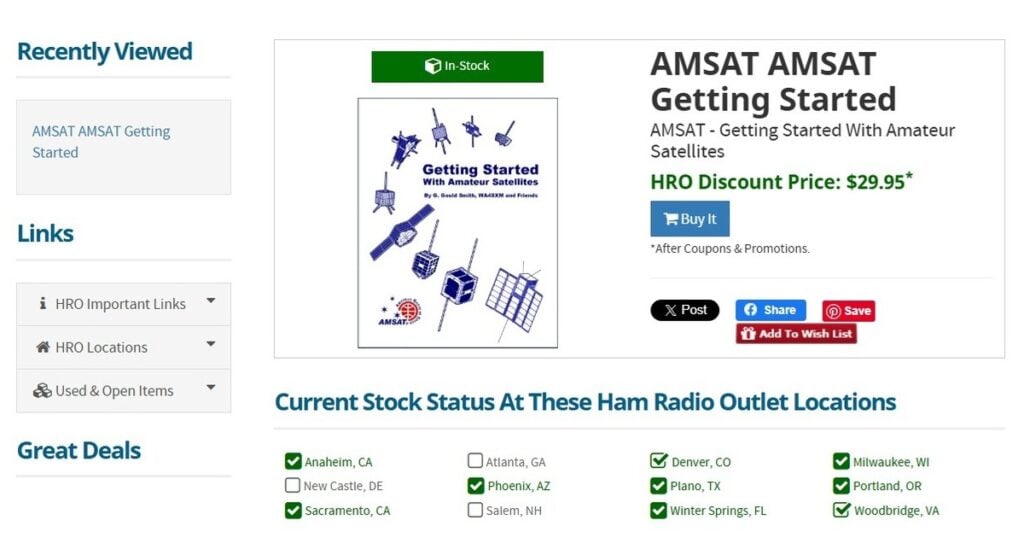 Available for $29.95 from HRO (free shipping on most orders over $100)
https://www.hamradio.com/detail.cfm?pid=H0-019238 Satellite Shorts from All Over
+ Five spacecraft are currently docked at the International Space Station after a SpaceX Dragon cargo capsule arrived on Thursday morning, delivering over 6,300 pounds of scientific experiments, crew supplies, and roll-out solar arrays. Station crew members have begun transferring critical biological research and preparing for upcoming spacewalks on Oct. 29 and Nov. 5 to install the new solar arrays, while Roscosmos cosmonauts completed robotics and spatial orientation studies. [ANS thanks NASA for the above information.]
+ Media representatives are invited to attend the Europa-Park Science Days from October 22–24, 2026, in Rust, Germany, featuring presentations, STEM activities, and media opportunities with ESA experts. Highlights on Thursday, October 22, include a keynote address and interview opportunities with German ESA astronaut Alexander Gerst, alongside talks by ESA directors and interactive exhibits spanning VR experiences, robotics, and planetary science models. [ANS thanks ESA for the above information.]
+ Using NASA’s Chandra X-ray Observatory, eROSITA, and LOFAR, scientists observed a merging galaxy cluster nicknamed the “treble clef” due to its distinct, music-note-shaped radio emission. Researchers report in Astronomy & Astrophysics that it was likely generated and amplified by a violent collision between two galaxy clusters. [ANS thanks Space.com for the above information.]
+ Scientists from the Indian Institute of Astrophysics (IIA) and international collaborators analyzed joint observations of solar coronal mass ejections (CMEs) captured by India’s Aditya-L1 and ESA’s Proba-3 satellites. By combining spectroscopic data from VELC aboard Aditya-L1 with imaging from ASPIICS on Proba-3, the cross-checked observations provided new insights into CME mass, density, thermal energy, and early-stage dynamics in the low solar corona. [ANS thanks The Hindu and ISRO for the above information.]
+ The Australian Space Agency and the Roo-ver Consortium unveiled the latest design model of “Roo-ver,” Australia’s first lunar rover, at the Queensland University of Technology’s Lunar Testbed and Space Lab during World Space Week on October 7, 2026. Scheduled to land at the lunar South Pole in 2030 aboard an Intuitive Machines lander under NASA’s Commercial Lunar Payload Services (CLPS) program, the semi-autonomous rover will collect and analyze regolith to support sustainable human exploration through the Artemis program. Designed to withstand extreme lunar temperature swings from -246°C to 121°C, the vehicle features homegrown Australian technology including specialized treaded wheels, thermal management systems, and tools to mitigate against lunar dust and radiation. [ANS thanks the Australian Space Agency for the above information.]
Join AMSAT today at https://launch.amsat.org/In addition to regular membership, AMSAT offers membership to:
- Societies (a recognized group, clubs or organization).
- Students enrolled in at least half-time status are eligible for free membership to age 25.
- Memberships are available for annual and lifetime terms.
Contact info [at] amsat.org for additional membership information.
73 and remember to help Keep Amateur Radio in Space!
This week’s ANS Editor,
Vidya Gopalakrishnan, K4VGK
ANS is a service of AMSAT, the Radio Amateur Satellite Corporation, 712 H Street NE, Suite 1653, Washington, DC 20002
AMSAT is a registered trademark of the Radio Amateur Satellite Corporation.
Categories: Amateur Radio News

Syndicate
Ohio News
Other News
- Advocates strategize how to better help survivors of human trafficking
- Glens Falls Hospital performs its first Barostim implant surgery
- SUV driver dies, multiple injured in Belleville-Henderson school bus crash
- Wanted man killed by State Police during traffic stop in Carthage
- Mountain Lake PBS, libraries to screen "Arrest the Midwife" Tuesday